Sunday, April 5, 2015

Matching wings and a history of a dream

Wright Brothers dream earth bhasiyechilena the wings, and the dreams of thousands of engineers and scientists at Dana is colorful and ever. The battlefield or sometimes save lives and sometimes bilasitaya Arab.
aeroplane-WarnersOf many years later, the world losing the natural eyanarji. Scientists meditating eyanarjira Only option to negotiate. Engineers determined that strengthened that feeling within aidiyake to implement. Dream wait another feather wings.
Yes, this dream a little higher at the Wright Brothers to the path shown. This dream world environmentalists. This is the dream of the people who increasingly panicky flight! Because of the amount of fuel it takes a flight is now unknown.
This dream came to know everyone who heard it? The gentleman who made the first balloon to orbit the earth. Yes, he is the Peakered Bernard! 003 people took this dream of his.bertrandpiccard_01Ship to fly in the sky, wings, showcasing again through Alternate sources. Through the solar eyanarjira !! And he had this dream last 8 July 010 implemented. 6 hours pulled himself out of the solar backup Fly a Plane "solar impalsa", HB-SIA prototype Who!

First atbaprakasa

solar_impulse_01
Why such a job that will be on the plane that was really the center of attraction. Before the release of Mr. Peakered neither seen him. The newly-law brought him out from behind a screen like the 009 in June.

Test Flight

solar_impulse_03
The first test flight last April. It was the first successful test flight cansei. Over 87 minutes of the test flight, the aircraft was able to reach an altitude of 3937 feet.

Stumble

solar_impulse_04
Big hocatera facts behind the big discovery. It was exceptional. After the successful test flight on July 1 announced the first official flight. However, it was not possible due to the mechanical golagera. On that day, he was hung on hangers in Switzerland.

Final Check

solar_impulse_05
Within one week of the first hocatera samadhana Peakered without all the problems of the seven in the morning, ready for the first 4 hours of flight. The film co-founder of the project and test pilot Andre basabarga Peakered taking talk with details.

Takeoff

solar_impulse_06
Finally, the golden moments. 51 minutes past 6am. Successful Takeoff!

Moment of Truth

solar_impulse_07
Here are some facts you need to say. Spacecraft to fly by day until gone, on the placement of the solar high paraparamensa 12000 eyare battery is a continuous charge. Tarei think everyone is getting evening darkness. What is it!

Landing

solar_impulse_08
Finally, a history is written. Fulfillment of a Dream and a sambhabanamaya future inventions. Landing has announced its next mission with Peakered with "Trans atalantika Flight" !!

The true owner of the Internet

Hello Community scream and saluted'm starting to tell me to tune today.
Let's imagination to go around for awhile. Gently close your eyes, it is a large room you're sitting. Admission of people all over the world, they say that which is their mother tongue. Gharamaya Refuse Chaos prevails, no one person can not understand. Now you can do whatever you put things on the table with a thump. Speaking as someone who does not understand a person? Then you define a standard for communication with them, and made rules so everyone can communicate with everyone. Internet is an arrangement in which the different countries yahayye different computers can communicate with each other to protect the rules. Unlike the specific policy will not be able to bear it
 

Internet (Internet)

Featuring a variety of Internet connections in a network. Said these connections are managed through specific rules and regulations called Protocols. This niyamaguloi simply established contacts in the network. But everything depends on the router infrastructure, network access point (Network Access Points (NAP) and computer systems.
 Then you need to send network traffic satellite (satellite), thousands and thousands of miles wide cable wireless router. The global system is made up of so many things that it could not be limited to anything, is beyond the country after country, the sea the ocean and mountains. Could not hold back any of this ongoing technology asirbadake border. It is connected to the network of day after day. It's like gematara mobile snake, eating and getting bigger. Almost every country in the world, the world of the Internet connection achebartamana everyone is covered by a specific network. Now the question is: Who is managing this vast network? Welcome to reply to it and inform the rest of the tune.

Who owns the Internet?

Many smaller systems that match the giants of the Internet, he can say that we have a special entities. Now this is the essence of a being who is? It is a control or a particular group of people, or? What's on your mind, you say? Is it really possible to control by any particular one? However, many questions may have puzzled look, let's have two options. Let's see whether it matches your idea.
  • A. None of these
  • B. Many people
If you think the Internet is a collective ownership of the single entity and not letting anyone. Then surely there's no specific organization which regulates the structure and function, but this does not have any ownership over the entire system. On a country's government can not establish ownership. Or you can think of thousands of people to own it. If you imagine the many roles, as the sum of the Internet, many people are working on the development of the people who own physical roles. Your thoughts, however, there is little difference in the actual event, but you have around. Not knowing what's the difference.

The true owner of the Internet

The physical network is called the transport of Internet traffic between computers on the Internet backbone (Internet Backbone). In earlier days the backbone of the system or the Internet Backbone has worked as ARPANET. But many companies who currently works as the backbone of the Internet through the router and the cable supply. The company is said to reinforce the Internet service providers, or ISP (Internet Service Provider). Now any country or someone who wants to get access to the Internet's course must contact the ISP. ISP or Internet service providers around the world to all the institutions of the famous stars are UUNET, Level 3, Verizon, AT & T, Qwest, Sprint, Sprint, IBMAgain, from the big ISP has created a small ISP. Who gives us the service. Here you need to keep in mind that our computer-to-computer data exchange system that is called Internet Exchange Points (IXP). Some of the various companies and non-profit organizations have to adjust it. Now the internet is different for each different ISPs. Now you are alone with a computer connected to the Internet, be sure you are the owner of the Internet. This means, you also own a portion of the Internet. Because the Internet is not owned. While many institutions or governments can build their own Internet called Local Area Network or LAN (Local Area Network). However, you and I have is that we are all different people mudda critical part owner of the Internet. He had claimed to be the owner himself, now that I think the question is how much responsibility you have these things? If you did not take the responsibility for all this to take responsibility?


So who is responsible for everything?

Although many of the above human nature at work can not take responsibility. How happy you made the same way as the owner of the Internet, if you put them in charge of the Internet, then you have to take the responsibility of the remote will kill me. However, I was told that some of the system of rules that we pratokalasa (Protocols) offering. According to the protocol of a computer network, the Internet provides information to another computer. Not comply with the protocol can not provide information on any computer. Now, if a protocol is not going to give you the assurance that you are providing the information to another computer, you have to come to terms. And the information will reach the right gantabyei.

 Now the Internet is that the rate of development of the twentieth century, the twenty-first century with the protocol protocol or protocol for the next year will remain the same with the previous year, it is absurd to contemplate. With the trust you need to improve and enhance the Internet Protocol. That's got, no one is going to change the rules of the protocol means. And you do not question, just for the Internet Protocol has a number of structures and organizations who are devoted to their duties. Let's assume that you know nothing about them.
  • The Internet Society: A nonprofit organization, the Internet, and is working to improve standards and policies set.
  • The Internet Engineering Task Force (IETF): This is an international organization whose membership is open to different groups based on the policy and they do not work. They are different things on the Internet for a different share of skilled manpower embraced every part of the organization. Significant contributions to the current Internet, the stability of the organization.
  • The Internet Architecture Board (IAB): They are usually formulated and standard Internet Protocol specification works.
  • The Internet Corporation for Assigned Names and Numbers (ICANN): This is a private organization, but a non-profit organization whose job it is to ensure that each domain name system (Domain Name System (DNS) does not have a link with the correct IP address.
Everything for the Internet, but the Internet in these groups can not claim. The thing is there is no ownership kendriyabhabe Internet. Some of it is still in development, but so far no one could claim it.

Last word

We have come to the end of tune. I do not know how much you like the tune. It was very difficult to work with one another was to insert the information, I've tried sarboccatuku knowledge with you to the right. I can understand your tiumenta understanding. Willy willy or bad you feel good tune tiumenta said. Your valuable suggestion will help me better tune and try to rectify. The Bengali language technology bhandarake small efforts will benefit. After all, everyone in the family requested it, we do not imitate anyone learn to follow. I try not to copy and paste your own presentation. After all, everyone needs to participate in my family to the rich. However, the next post will meet today to conclude. I like it so far, to stay healthy and stay safe. And I'm looking forward to your tiumentera ................
 

Saturday, April 4, 2015

Analysis: Yemen needs hope not bombs

The mounting number of civilian casualties is raising fears over an already deteriorated humanitarian situation.


Six out of every ten Yemenis are without adequate food, clean water and access to basic services, according to OXFAM [Getty]
Wars without well-defined strategic goals tend to result in tribulation and suffering as opposed to solving political conflicts. Saudi Arabia's King Salman has outlined the broader political objectives of his coalition military operation in Yemen, Decisive Storm, which include ending the Houthis' military control of Yemeni cities and returning the legitimate president, Abd-Rabbu Mansour Hadi, and his government to power in Sanaa.
To this end, the Decisive Storm operation has conducted more than six continuous days of heavy air strikes targeting key military camps and administrative areas in several parts of the country under the control of Houthis and former President Ali Abdullah Saleh loyalists.
The military operation has also heavily targeted the headquarters of the Houthis' leader, Abdel-Malik al-Houthi, in the area of Maran in Saada province, the stronghold of Houthis.

RELATED: 'I hope we do not turn into another Syria'

Although aggressive Saudi-led air strikes have succeeded - so far - in halting Houthis' advancement, they have not yet weakened the Houthis to an extent that they will stop fighting and accept the political demands of King Salman and President Hadi.
It is clear, however, that these air strikes have caused significant damage to Yemen's already crumbling infrastructure, including airports, military air bases, roads, military facilities and camps, and overall military capabilities and weaponry systems, particularly the country's anti-aircraft defence systems. 
Yemenis are confused by the sudden and unexpected turn of events in their country and wonder whether the Arab coalition that is causing such destruction in their country will ultimately save them.
Although al-Qaeda in Yemen is currently downplaying its political response to the Saudi-led military operation because it is targeting a common enemy, the Houthis, they will likely attempt to exploit the destruction of Yemen's military forces in the future.  
Thus, Saudi Arabia, and its allies, must develop and rapidly implement plans to restore modern and effective Yemeni armed forces at the conclusion of their military operations in order to protect the territorial integrity and sovereignty of the country.
In addition to the widespread destruction, there has also been a substantial humanitarian cost in this military operation. Many supporters of the Saudi-led coalition are concerned about the number of civilian deaths resulting from the ongoing military air strikes.
Yemenis are confused by the sudden and unexpected turn of events in their country and wonder whether the Arab coalition that is causing such destruction in their country will ultimately save them. 

OPINION: What they won't admit at the Arab summit

Yemeni social media and local media outlets have circulated heartbreaking images of civilian victims, including women and children, who were burned to death in air strikes near Sanaa International Airport, at a refugee camp near Saada, and in the town of Yarim in Ibb province.
At least 93 civilians were reported to have been killed since March 27 and a further 364 injured in Sanaa, Sada, Dhale, Hudayda and Lahj, among whom were "dozens" killed in an air strike on the al-Mazraq camp for internally displaced persons that was established by the UN in 2009.
At least another 35 were injured in the raid, including 11 children.
The number of civilian casualties is greater in the south as a result of direct military clashes between pro-Hadi tribal and militia forces backed by the Saudi-led coalition and Houthi rebels supported by Saleh loyalists in the Yemeni army.  
Moreover, media reports that the Saleh-Houthis alliance has intentionally provoked battles in civilian areas will further complicate the Saudi military mission by increasing the potential for civilian casualties.  
Arab League summit: Can it bring peace to the region?
In the south, the war has been intensified by Saleh's recent failure to take Aden by force and his anticipated determination to make another attempt in partnership with the Houthis will significantly increase civilian suffering in this part of the country. 
King Salman has yet to directly address the Yemeni people and explain the political goals of his country's operation in order to win the hearts and minds of the Yemenis.
A Saudi offer of financial compensation for victims' families and medical treatment for the wounded could represent an important first steps towards gaining the support of the Yemeni people. But no amount of compensation can heal the unseen wounds of this war-torn nation.
Even before the start of the Decisive Storm operation, the humanitarian situation in Yemen was of grave concern to many international humanitarian organisations, including OXFAM, which warned that more than six out of every ten Yemenis are without adequate food, clean water and access to basic services - including approximately a million children who are suffering from extreme malnutrition.
Moreover, several million Yemenis lack easy access to clean water and basic healthcare services.
Thus, international humanitarian aid to Yemen is critical at this juncture. Yemenis have long viewed the Gulf Cooperation Council (GCC) as a symbol of hope for a new Yemen in which they can find jobs and pursue their personal dreams.
They hope that one day Yemen will be admitted to this very wealthy club. Although the GCC has finally decided to help them, the Yemenis are receiving bombs and fires but no hope.
Source: Al Jazeera

Ethnic tensions between Israeli Jews fuel Netanyahu victory


Apr 4, 2:06 AM EDT

Ethnic tensions between Israeli Jews fuel Netanyahu victory

AP Photo
AP Photo/Dan Balilty

Buy AP Photo Reprints
Multimedia
Assault on Gaza: Mapping the attacks
Gaza assault takes its toll on children
A closer look at Hamas
Latest News
Ethnic tensions between Israeli Jews fuel Netanyahu victory
PHOTO GALLERY
AP Photo
ROSH HA'AYIN, Israel (AP) -- Israel's visceral election campaign has exposed a rift that many here thought had long subsided - the deep-seated schism between Jews of European and Middle Eastern descent.
Mizrahi, or Middle Eastern, Jews heavily backed Prime Minister Benjamin Netanyahu's Likud Party, while Ashkenazi, or European, Jews mostly identified with the opposition Zionist Union.
That dynamic has been going on for a while but passions have run particularly high this time, with jarring results. Since Netanyahu's win, the sides have been exchanging insults that have not been heard in public in a generation - with the Mizrahi voters accused of being primitive and Ashkenazi voters viewed as elitist.
The dispute goes back to Israel's earliest days of independence. Arriving from Arabic-speaking countries in the Middle East and North Africa after Israel's establishment in 1948, many Mizrahi immigrants were sent to shantytown transit camps and largely sidelined by the European leaders of the founding Labor Party.
They found their political savior in Likud's Menachem Begin - even though he was himself of Polish Jewish descent. With consummate skill the longtime opposition leader cultivated an outsiders' alliance that appealed to their sense of deprivation - and with massive Mizrahi backing he swept to power in 1977 to break nearly 30 years of Labor rule.
The exact population breakdown is hard to calculate because intermarriage is now quite common. But Mizrahi or part-Mizrahi Jews make up roughly half of Israel's Jewish population.
They have long complained of discrimination by the European-descended elite that traditionally dominated government, military and business institutions.
The complaints have diminished, as has some of the domination, but gaps remain. There has never been a Mizrahi prime minister, for example. Mizrahim far outnumber Ashkenazim in prison - and are far outnumbered in academia.
They also account for many more poor people - and yet the poorest towns, where they predominate, tend to support Likud and forgive it the capitalist policies than have often not served their economic interests.
"Our parents and grandparents have voted only Likud since the upheaval" of 1977, said Malkiram Bashari, who traces his roots to Yemen.
The prospect of voting for Labor? "It's too hard. There is just too much baggage there," said Bashari, 52.
Such sentiments are nothing less than mind-boggling for affluent Ashkenazi voters - who cannot grasp why Mizrahim would support Likud in an election when the country's high cost of living was supposedly a central issue.
They also often argue that Netanyahu's hard-line policies toward the Palestinians prevent a peace agreement that would bring on an economic boom that would benefit Mizrahim.
Yet voting patterns from this month's election indicate that Netanyahu largely owes his re-election to the last-minute mobilization of Likud's Mizrahi supporters.
Many had pledged to turn their back on Likud to protest its economic policies or because of disdain for Netanyahu's lengthy rule and perceived decadent lifestyle.
But when the moment of truth arrived - and after Netanyahu sparked turnout by warning of Arab voters coming out in "droves" - poorer, heavily Mizrahi "development towns" voted en masse once more for Likud over the Zionist Union, Labor's modern-day incarnation.
In Sderot, for example, a border town with Gaza that has been battered by both rockets and unemployment and has long complained of government neglect, Likud earned 43 percent of the vote, to the Zionist Union's 7 percent.
"The politics of identity are stronger than any economic interest," said Gideon Rahat of Jerusalem's Hebrew University and the Israel Democracy Institute.
He said the ethnic vote goes both ways and helps explain why even the wealthiest Ashkenazim continue to vote Labor - which favors high taxes on the rich - rather than the more capitalist Likud.
For years, as Mizrahi Jews made inroads throughout Israeli society, the rift with the Ashkenazim took a back seat to the conflicts between Arabs and Jews, and between secular and religious Jews.
But the ethnic genie was let out of the bottle at a pre-election left-wing rally in Tel Aviv, where Ashkenazi artist Yair Garbuz complained about a "handful of amulet kissers that have taken over the country." Other condescending remarks, including a Facebook post by leftist writer Alona Kimhi that referred to right-wing voters as "Neanderthals" and suggested they "drink cyanide," sparked further outrage.
The Shas party, which caters to religious Mizrahi Jews, tapped into the controversial comments and launched a campaign provocatively titled: "A Mizrahi votes for a Mizrahi."
The bitterness continued after the vote. The nadir came during a TV morning show, when a radical professor known for his online tirades against Mizrahi immigration lashed out at a fellow panelist that "nothing bad would have happened had your parents been left to rot in Morocco."
Nehemia Shtrasler, a columnist for the liberal Haaretz daily newspaper and an Ashkenazi Jew, said the left's historic discrimination of Mizrahim had come back to bite it.
"It wasn't the diplomatic-security issue that won the election," he wrote. "It was all about ethnicity, and revenge was served up cold at the ballot box."
Netanyahu, whose hard-line rhetoric taps into Mizrahi disdain for the Arabs who mistreated them in their countries of origin, "speaks not only fluent English, but also fluent Mizrahi," wrote Avi Issacharoff in the Times of Israel website.
In Rosh Ha'ayin, a former dusty town now on the outskirts of the greater Tel Aviv metropolis, these sentiments ring true.
"Bibi knows our mess. He is good for us," said 32-year-old Shalom Tairy, who runs a hummus restaurant in the Yemenite neighborhood of Shabazi, referring to Netanyahu by his nickname.
"He knows how to talk. He knows how to make every `fool' not feel like a `fool' and raise his morale," Tairy added.
Sitting next door, drinking Turkish coffee and smoking cigarettes at a local convenience store, the neighborhood elders say Shabazi has always been a Likud stronghold and that is how it will remain.
They angrily recalled how Mizrahim were denied good jobs, passed over for promotions in the military and police, beaten in school and prevented a good education. They insisted that Israel's founding father David Ben-Gurion didn't even want them to come.
"We should be regarded like Holocaust survivors," said Uri Barzilai, 60. "We were treated like third-rate citizens and we still feel damaged."
----
Follow Aron Heller on Twitter at http://www.twitter.com/aronhellerap
© 2015 The Associated Press. All rights reserved. This material may not be published, broadcast, rewritten or redistributed. Learn more about our Privacy Policy and Terms of Use.

Fighting intensifies in the streets of Yemen's Aden

Rebels have engaged in intense street battles with forces loyal to President Abd-Rabbu Mansour Hadi in Yemen's southern port city of Aden.
The UN Security Council is set to meet on Saturday to discuss a Russian proposal for "humanitarian pauses" in Saudi-led air strikes, which have targeted Houthi rebels over the past nine days.
As the country continued to spiral into chaos on Friday, Houthi fighters and their allies withdrew from Aden's Crater neighbourhood, as well as one of Aden's presidential residences which they had seized a day earlier, residents and a local official said.
Their withdrawal followed clashes and an air strike on the presidential palace at Ma'ashiq, overlooking Crater. At least one Houthi tank was destroyed and another taken over by Hadi's loyalists, they said.
Fighters backing Hadi said they had killed at least 10 Houthis in the clashes in Aden, but did not comment on losses in their ranks.
The Saudi-led coalition dropped weapons and medical supplies to aid pro-Hadi forces in their fight for control of Aden on Friday. The crates of light weapons, telecommunications equipment and rocket-propelled grenades were parachuted into Aden's Tawahi district, on the far end of the Aden peninsula which is still held by Hadi loyalists, Hadi loyalists told the Reuters news agency.
Despite the assistance, pro-Hadi fighters called for further help.
"We urge the coalition to parachute troops on the ground because the strikes from the air and sea won’t be enough," said one fighter, who identified as belonging to the Southern Youth Resistance.
"There must be forces on the ground, the people here are under bombardment... there are deaths, and families remain under siege, we can’t get to them."
Brigadier General Ahmed al-Asiri, a spokesman for the Arab coalition told a news conference air strikes had significantly degraded the Houthi fighters' military capabilities and Hadi loyalists had gained ground in Aden.

RELATED: Yemen is a defining moment for King Salman

The Saudi-led coalition involves six nations that belong to the Gulf Cooperation Council.
The Houthis are backed in their push by military forces and police loyal to former President Ali Abdullah Saleh. 
Houthis advance despite strikes
Despite inflicting heavy losses on the Houthis, the Saudi-led air strikes might not be enough to halt their advance, said Al Jazeera's Mohamed Vall, who has reported extensively on Yemen.
"They [Saudi-led coalition] know they cannot win this war without putting troops on the ground...they are probably waiting for more weakening of Houthi defences [before they do that]," he said.
The UN Security Council will meet to discuss Yemen's crisis at 15:00 GMT on Saturday.
UN aid chief Valerie Amos said on Thursday she was "extremely concerned" about civilian deaths after agencies reported that 519 people had been killed and nearly 1,700 injured in two weeks of fighting.
Also on Friday, al-Qaeda in the Arabian Peninsula, as the Yemen branch is named, consolidated its hold of Mukalla, which they overran on Thursday, seizing its port and a major army base there.
The group has benefited from Yemen's political crisis ever since the Houthis first surged from their northern strongholds last year to seize Sanaa, and much of the north.
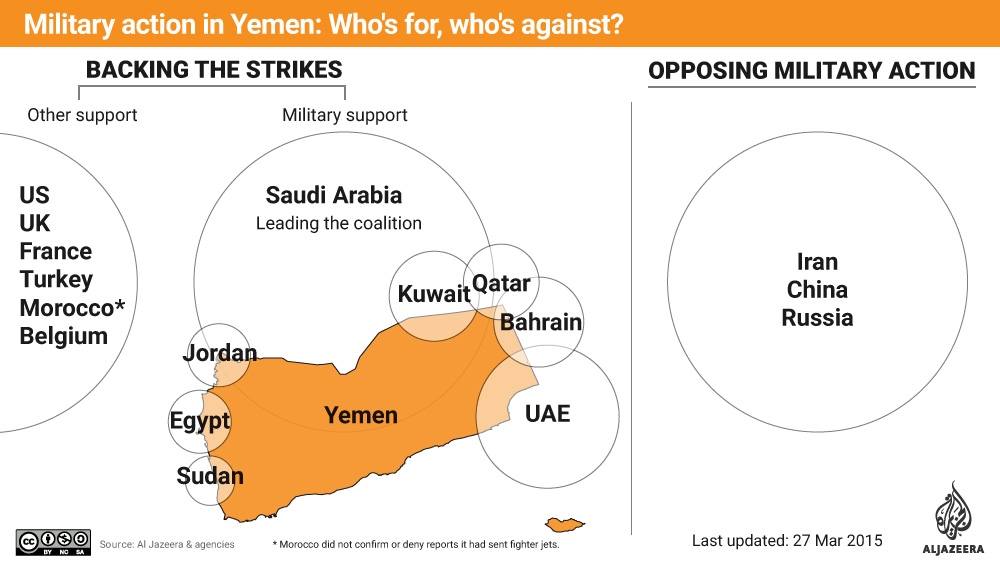
Infographic: Who's for and against military action in Yemen [Al Jazeera]
Source: Al Jazeera and agencies

Malaysia

Malaysia (Listeni/məˈleɪʒə/ mÉ™-LAY-zhÉ™ or Listeni/məˈleɪsiÉ™/ mÉ™-LAY-see-É™) (Malaysian pronunciation: [mÉ™lejsiÉ™]) is a federal constitutional monarchy located in Southeast Asia. It consists of thirteen states and three federal territories and has a total landmass of 329,847 square kilometres (127,350 sq mi) separated by the South China Sea into two similarly sized regions, Peninsular Malaysia and East Malaysia (Malaysian Borneo). Peninsular Malaysia shares a land and maritime border with Thailand and maritime borders with Singapore, Vietnam, and Indonesia. East Malaysia shares land and maritime borders with Brunei and Indonesia and a maritime border with the Philippines. The capital city is Kuala Lumpur, while Putrajaya is the seat of the federal government. By 2015, with a population of over 30 million, Malaysia became 43rd most populous country in the world. The southernmost point of continental Eurasia, Tanjung Piai, is in Malaysia, located in the tropics. It is one of 17 megadiverse countries on earth, with large numbers of endemic species.
Malaysia has its origins in the Malay kingdoms present in the area which, from the 18th century, became subject to the British Empire. The first British territories were known as the Straits Settlements, whose establishment was followed by the Malay kingdoms becoming British protectorates. The territories on Peninsular Malaysia were first unified as the Malayan Union in 1946. Malaya was restructured as the Federation of Malaya in 1948, and achieved independence on 31 August 1957. Malaya united with North Borneo, Sarawak, and Singapore on 16 September 1963, with si being added to give the new country the name Malaysia. Less than two years later in 1965, Singapore was expelled from the federation.
The country is multi-ethnic and multi-cultural, which plays a large role in politics. The constitution declares Islam the state religion while allowing freedom of religion for non-Muslims. The government system is closely modelled on the Westminster parliamentary system and the legal system is based on common law. The head of state is the king, known as the Yang di-Pertuan Agong. He is an elected monarch chosen from the hereditary rulers of the nine Malay states every five years. The head of government is the prime minister.
Since its independence, Malaysia has had one of the best economic records in Asia, with its GDP growing at an average of 6.5% per annum for almost 50 years. The economy has traditionally been fuelled by its natural resources, but is expanding in the sectors of science, tourism, commerce and medical tourism. Today, Malaysia has a newly industrialised market economy, ranked third largest in Southeast Asia and 29th largest in the world. It is a founding member of the Association of Southeast Asian Nations, the East Asia Summit and the Organisation of Islamic Cooperation, and a member of Asia-Pacific Economic Cooperation, the Commonwealth of Nations, and the Non-Aligned Movement.

From today's featured article

From today's featured article

A Douglas DC-6
On April 4, 1955, a United Airlines Douglas DC-6 crashed (similar aircraft pictured) shortly after taking off from Long Island MacArthur Airport, in the U.S. community of Ronkonkoma in Islip, New York. The aircraft, named Mainliner Idaho, began banking to the right after takeoff, then swerved 90 degrees, nosedived, and hit the ground, killing all three crewmembers. An investigation found that they had been simulating an engine failure on an instrument rating check flight, but had pulled back the throttle lever for engine No. 4 too far, causing the propeller blades to reverse, a feature normally used only to slow the aircraft during landing. They had also failed to raise a metal flag in the cockpit that would have allowed the blades to return to the proper position during flight. Investigators from the Civil Aeronautics Board concluded that crew lost control of the aircraft when they applied full power to No. 4 engine, and that the sudden bank and dive left the crew little time to recover from their mistake. After the investigation, the Civil Aeronautics Administration issued an Airworthiness Directive ordering all United Douglas DC-6 and DC-6B aircraft to be fitted with a manual device to prevent the inadvertent reversal of the blades. (Full article...)
Recently featured: Amphetamine – The Fifth Element – Invisible rail

Friday, April 3, 2015

What 100 Calories of Your Favorite Halloween Candy Actually Looks Like

Butterfinger1 fun-size bar=100 caloriesButterfinger is the most decadent on our list of chocolate treats. Sure, you can have only one, but its buttery flakes get stuck to your teeth for a few minutes, making it hard to scarf down a bunch in one sitting anyway.

1 fun-size bar=100 calories
Butterfinger is the most decadent on our list of chocolate treats. Sure, you can have only one, but its buttery flakes get stuck to your teeth for a few minutes, making it hard to scarf down a bunch in one sitting anyway.
BING: Butterfinger recipes
Just because you’re trying to lose weight doesn’t mean you need to avoid Halloween candy altogether. How sad would that be?! Nor does it mean you should opt for a kind you like less in order to save a few grams of sugar or fat. Instead, satisfy your inner trick-or-treater with 100-calorie portions of the candy you want most. Here’s a handy guide to what that looks like.

Snickers1 1/3 fun-size bars=100 caloriesAlthough you can’t avoid the unhealthy fats found in candy bars, the peanuts will not only replace some of the bad fats and calories but also supply you with heart-healthy monounsaturated fats, says Karolina Starczak, R.D. “The best perk, of course, is that the mix of fat, protein, and fiber slows digestion, keeping your hand out of the candy bowl a little longer.”

1 1/3 fun-size bars=100 calories
Although you can’t avoid the unhealthy fats found in candy bars, the peanuts will not only replace some of the bad fats and calories but also supply you with heart-healthy monounsaturated fats, says Karolina Starczak, R.D. “The best perk, of course, is that the mix of fat, protein, and fiber slows digestion, keeping your hand out of the candy bowl a little longer.”
BING: Snickers recipes

Nestlé Crunch1 1/2 fun-size bars=100 caloriesChocolate bars may have more fat than Skittles or Sour Patch Kids, but if you’re a chocoholic, Crunch bars are a not-so-bad way to get your cocoa-and-crunch fix.

1 1/2 fun-size bars=100 calories
Chocolate bars may have more fat than Skittles or Sour Patch Kids, but if you’re a chocoholic, Crunch bars are a not-so-bad way to get your cocoa-and-crunch fix.
BING: Nestlé Crunch recipes

Kit Kat2 fingers =100 calories Want to keep your diet in check? Here’s your cue to stash half of that full-size candy bar in your desk, or share a piece. The song does ask you to break someoneelse off a piece of that Kit Kat bar, after all.

2 fingers =100 calories
Want to keep your diet in check? Here’s your cue to stash half of that full-size candy bar in your desk, or share a piece. The song does ask you to break someone else off a piece of that Kit Kat bar, after all.
BING: Kit Kat recipes

Reese’s Peanut Butter Cups2 1/5 miniatures=100 caloriesThe full-size Reese’s Peanut Butter Cup has more than 100 calories, so you’ll likely feel more satisfied by two minis (we’re guessing you won’t bother carving out 1/5 of a miniature Reese’s cup). Plus, it will take you longer to unwrap them. More packaging always equals more time to think about if you really want another serving.

2 1/5 miniatures=100 calories
The full-size Reese’s Peanut Butter Cup has more than 100 calories, so you’ll likely feel more satisfied by two minis (we’re guessing you won’t bother carving out 1/5 of a miniature Reese’s cup). Plus, it will take you longer to unwrap them. More packaging always equals more time to think about if you really want another serving.
BING: Reese's peanut butter cup recipes2 1/2 minis=100 caloriesGood news: Twix has the least amount of sugar of all the Halloween candy we put to the test. It’s the only one with fewer than 10 grams per 100-calorie portion.

Twix

2 1/2 minis=100 calories
Good news: Twix has the least amount of sugar of all the Halloween candy we put to the test. It’s the only one with fewer than 10 grams per 100-calorie portion.
BING: Twix recipes

Hayley Okines: Progeria campaigner 'with the body of a 100-year-old' dies age 17

A girl with a rare ageing disease who became known as the "100-year-old teenager" has died at the age of 17.
Hayley Okines was born with Progeria, a rare condition that caused her body to age eight times faster than normal. 
PA: Hayley Okines, who suffered from progeria has died at the age of 17 © PA Hayley Okines, who suffered from progeria has died at the age of 17 Progeria usually begins within the first two years of birth, when symptoms such as slow growth and hair loss began to appear. The average life expectancy for a child with the disease is just 13, but Hayley defied all odds and lived for another four years.
Hayley, from Bexhill, in East Sussex, became a spokesperson and fundraiser for the condition and campaigned for greater awareness throughout her teens. She released her autobiography at the age of 14, entitled Old Before My Time.
She had been treated in hospital for pneumonia over the past few days and returned home on Thursday. She died on the same day, according to the BBC.
Her mother Kerry confirmed her death on Thursday evening on Facebook, writing: "My baby has gone somewhere better. She took her last breath in my arms at 9.39pm."
The US-based Progeria Research Foundation paid an emotional tribute to Hayley on its Facebook page, where it said: “The entire Progeria family mourns together with many as we say goodbye to Hayley Okines, our smart, beautiful and spirited English Rose.”
Comments have been flooding in on a Facebook page dedicated to the teenager. One user praised Hayley's strength and determination, writing: "God bless you Hayley. Your positive outlook and willingness to share your life's journey with us has been very much appreciated."

Sarah Brady, gun control advocate, dies at 73

Sarah Brady, who became a gun-control advocate after her husband James Brady was shot in the 1981 assassination attempt on Ronald Reagan, died Friday at 73. The Bradys were key in passing the Brady Handgun Violence Prevention Act, which introduced background checks to the purchasing process. James Brady passed away in August 2014.

Sarah Brady, gun control advocate, dies at 73

The Hill Sarah Brady, wife of James Brady, the White House press secretary who was seriously injured in the 1981 assassination attempt against President Ronald Reagan.

Federal judge orders California inmate be granted sex change


This March 28, 2014 photo provided by the California Department of Corrections and Rehabilitation shows Michelle-Lael Norsworthy. A federal judge on Thursday, April 2, 2015, ordered California’s corrections department to provide the transsexual inmate with sex change surgery, the first time such an operation has been ordered in the state. California Department of Corrections and Rehabilitation/APA federal judge Thursday ordered that a California prison inmate be allowed to undergo gender reassignment surgery.
Should the operation occur, it will be the first in state prison history and cost as much as $100,000, according to Joyce Hayhoe, spokeswoman for California Corrections Health Care Services.
U.S. District Court Judge Jon Tigar in San Francisco ruled that Michelle-Lael Norsworthy's constitutional rights were being violated if the inmate's "serious medical need" was not met, according to the ruling.
Norsworthy, 51, is housed at Mule Creek State Prison in Ione. Norsworthy, born Jeffrey Bryan Norsworthy, was convicted of murder, according to the Associated Press.
Norsworthy, who has identified as a woman since the 1990s, has suffered severe dysphoria, or dissatisfaction with her life, because of her natural-born gender, Tigar said in the ruling.
"The weight of the evidence demonstrates that for Norsworthy, the only adequate medical treatment for her gender dysphoria" is sexual reassignment surgery, Tigar said in his ruling.
The Department of Corrections denied the "necessary treatment" for reasons unrelated to medical need, according to the ruling.
"The evidence suggests that Norsworthy's request for SRS was denied because (the Department of Corrections) has a blanket policy barring SRS as a treatment for transgender inmates," Tigar wrote.
State prison officials are considering appealing the ruling, the Associated Press reported.
Norsworthy entered prison in April 1987, according to records. She began identifying as a woman in the 1990s and was diagnosed with dysphoria in January 2000, according to the ruling.
The operation is to take place in the near future, according to the ruling.
"Defendants shall take all of the actions reasonably necessary to provide Norsworthy sex reassignment surgery as promptly as possible," according to the ruling.
Hayhoe said her office is reviewing the ruling to "determine the next steps."
Surgical operations do not take place at prisons in California, Hayhoe said. All operations, including Norsworthy's should it happen, are done at community hospitals.

Powdered Alcohol Meets Resistance in U.S. Before It Even Comes to Market

Concerned over the potential for abuse, six states have passed legislation to ban powdered alcohol outright, according to the National Conference of State Legislatures.In 2012, Mark Phillips needed a way to market his new invention: a powdered form of alcohol that could be mixed with water.
You could sprinkle it on guacamole, although snorting it would get you drunk quickly and was probably not a good idea, Mr. Phillips wrote online in those earlier days.
But now, Mr. Phillips has come to the attention of state and federal lawmakers who want to ban his product — which he says was inspired by a love of hiking but a distaste for carrying bottles of adult beverages uphill — and those statements have come back to haunt him.
Concerned over the potential for abuse, six states have passed legislation to ban powdered alcohol outright, according to the National Conference of State Legislatures. And Senator Charles E. Schumer, a New York Democrat, introduced a bill last month that would ban its sale and manufacture nationwide.
Mr. Phillips is not the first to develop a powdered form of alcohol. It has been produced in Europe and Japan, and patents have been issued before in the United States. Mr. Phillips’s version, developed by his firm, Lipsmark of Tempe, Ariz., was approved for sale last month by the Alcohol and Tobacco Tax and Trade Bureau. However, it is still subject to state regulation.
In response to the growing opposition, Mr. Phillips has vigorously defended his product, called Palcohol, saying it is no more dangerous than the liquid version sold in liquor stores. Gone are the suggestions about guacamole and snorting, which he says were published on Palcohol’s website by mistake and were never a part of the marketing strategy. They have been replaced with an emphasis on the practical advantages of a lightweight drink and the need to use the product responsibly.
To demonstrate the earlier error of his ways, Mr. Phillips said he even snorted Palcohol to prove that it was not an effective or quick way to get drunk, which he said he had not done before he made his earlier claims. The experience was, in a word, unpleasant.
“It would take you an hour of pain to ingest the equivalent of one drink,” Mr. Phillips said in an interview. “It really burns.” Palcohol’s website now says that snorting would be impractical and unpleasant.
The change of course may not be enough for lawmakers, however, said George Fisher, a professor of law at Stanford University who has studied the history of alcohol regulation. Since Palcohol’s website initially suggested that snorting the product was a way to get drunk quickly — even if doing it was unwise — “lawmakers, I suspect, will be inclined to take the marketer at the marketer’s original word,” he said.
Opponents of powdered alcohol said it could increase the chances of underage drinking and abuse, an assertion Mr. Phillips disputes. Senator Schumer referred to the product as “Kool-Aid,” while others say they worry that its powdered form makes it easier to conceal.
Earlier posts on Palcohol’s website suggested bringing it into movie theaters and stadiums, although Mr. Phillips said he always encouraged people to use his product responsibly and legally.
“My worry would be for children to get a hold of it,” said JoAnn Windholz, a member of the Colorado House of Representatives. Before the Alcohol and Tobacco Tax and Trade Bureau approved Palcohol for sale, Ms. Windholz introduced a bill in the Colorado General Assembly that would have banned the product. The General Assembly passed a modified version of the bill that required the state to figure out how to tax and regulate powdered alcohol, much as it does marijuana.
Despite the opposition, Mr. Phillips hopes to have Palcohol on store shelves by the summer. Because of regulatory uncertainty in the United States, he says, he has looked at ways to manufacture Palcohol overseas.
The goal is to create five versions: rum, vodka and three mixed drinks, Cosmopolitan, Lemon Drop and a margarita version called Powderita, according to the company’s website. Each version will be sold in single-use packets, Mr. Philips said, which consumers can mix with six ounces of liquid to make one drink. Each drink will have 10 percent alcohol by volume, about the equivalent of a glass of wine.
Mr. Phillips said his mixed drinks were not sweet enough to be compared to Kool-Aid and he was not aiming at children. The packages, at 4 inches by 6 inches, are not easily concealed, he said. And because of the single-use packaging, he said, it would be easier to spike a punchbowl with a large bottle of rum.
Amy George, a spokeswoman for Mothers Against Drunk Driving, said MADD did not typically take a stand on the dangers of specific alcohol products, but it was generally concerned that colorful or playful packaging of such products can sometimes appeal to children.
Colleen Sheehey-Church, MADD’s national president, said, “We don’t have a position on how it’s sold as long as it’s only sold to those who are 21 or over.”
In March, Maryland’s comptroller, Peter Franchot, announced an agreement with alcohol industry trade groups to voluntarily refrain from distributing or selling powdered alcohol. He said consumers could create dangerous drinks by mixing multiple packets of palcohol into a single drink.
“The likelihood of widespread Palcohol abuse — particularly among underage consumers — carries a real possibility of tragic consequences,” Mr. Franchot said in a statement, “which is why I’m so pleased by the industry’s unified response to protect the public from such a dangerous product.”
In the past, the Food and Drug Administration has weighed in on some alcoholic products, like the beverage Four Loko. Its makers removed caffeine from it after receiving a warning letter from the F.D.A.
Nevertheless, the F.D.A. has not become involved with Palcohol. In a statement on its website, the agency said that the ingredients in Palcohol were typical of those found in many processed foods and that they complied with F.D.A. regulations.
Nonetheless, Alaska, Louisiana, South Carolina, Utah, Vermont and Virginia have taken regulatory action, according to the conference of state legislators.
Mr. Phillips said he doubted that statewide bans on Palcohol would do much to limit its use.
“There’s nothing good about the ban,” Mr. Phillips said. “If you don’t regulate it, you’re making it easier for kids to get a hold of it, just the opposite of what their intention probably was.”
Dr. Ryan Stanton, an emergency physician and spokesman for the American College of Emergency Physicians, said that although powdered alcohol has been sold outside the United States, he had not seen evidence that it had been abused or that it was more dangerous than regular alcohol.
“I do believe alcohol, no matter which way it’s delivered, is still a big health and safety risk in the United States,” he said. “I’ll be interested to see what people do to make this dangerous. Because I’m sure somebody will figure out a way to make this dangerous.”