Wednesday, June 10, 2015

The children taken from home for a social experiment

In the 1950s, a group of Inuit children were taken from their families in Greenland to be re-educated as model Danish citizens. More than 60 years later, they want the Danish government to apologise for an experiment that did enormous damage.
"It was a lovely summery day, when two grand Danish gentlemen showed up at our house," says Helene Thiesen. It was 1951 and she lived with her family in Nuuk, the capital of Greenland.
"They had an interpreter with them and my older sister and I thought: What are they doing here? We were very curious. We were told to go outside while mum spoke to them.
"They asked my mum if she would be willing to send me to Denmark. I would learn to speak Danish and get a good education - they said it was a great chance for me.
"My mum said, 'No,' to them twice. But they kept pushing her and said we think you should send Helene to Denmark, it's only for six months. And she'll get the chance of a bright future - so we think you should let her go."
Helene Thiesen (bottom left), with her parents and siblings
Helene Thiesen (bottom left), with her parents and siblings in Greenland
line

Find out more

Listen to Denmark's Inuit Experiment from 08:50 BST on Wednesday 10 June onWitness on BBC World Service Radio.
line
Denmark had resolved to improve living conditions in its Arctic colony. Many people still made a living by hunting seal, only a small percentage spoke Danish, and tuberculosis was widespread.
The best way to modernise the island was to create a new type of Greenlander, the Danish authorities decided, so they sent out telegrams to priests and headteachers asking them to identify intelligent children between the ages of six and 10. The plan - formed with the help of the charity Save the Children Denmark - was to send them to foster families in Denmark so they could be re-educated as "little Danes".
Many parents were reluctant to give up their children but eventually 21 families gave in.
Helene Thiesen's father had died from tuberculosis three months earlier and her mother was left on her own with three young children.
"My mum crouched down and explained to me, 'You're going to Denmark.' I said, 'What's Denmark?'
"'It's a country very far away,' mum said. 'But it's beautiful, it's just like paradise. You don't have to be sad,' she said."
In May 1951, the ship MS Disko set sail from Nuuk with 22 children on board.
"We walked down to the harbour from our house, with my little suitcase," says Thiesen.
"From the boat, I looked at my mum and I couldn't wave at her. I was too upset. I just kept my arms down. I thought, 'Why are you letting me leave?' We couldn't understand why they were shipping us away. What lay ahead? Everything was so uncertain.
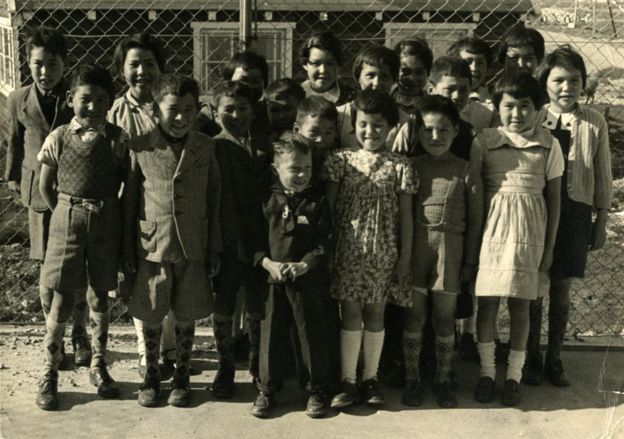
The children gathered together in Greenland
Helene Thiesen is on the far right of this picture, taken in Greenland
"I remember arriving in Copenhagen. It was dusk and it was a very big harbour. And I thought my mum was wrong because I could see there were mountains in Denmark. But when we got closer I realised it was actually trees that looked like mountains. We didn't really know what they were. But they were tall and green and alive."
After they arrived in Denmark, the children were sent to live with foster families. But first they had to spend the summer at what was described as a "holiday camp", known as Fedgaarden.
"It later emerged that we were actually in quarantine," says Thiesen.
"The farm was so remote, we never saw any other houses. And we were quarantined because it was the first time a group of young children from Greenland had arrived in Denmark. There were fears that we could have something contagious.
"I kept thinking, 'What are we doing here and when are we going home?' I missed my mother and I was grieving for my dead father. I couldn't understand why I was being sent so far away."
The arrival of the Inuit children was such a prestigious project that the Queen of Denmark paid a visit to the camp.
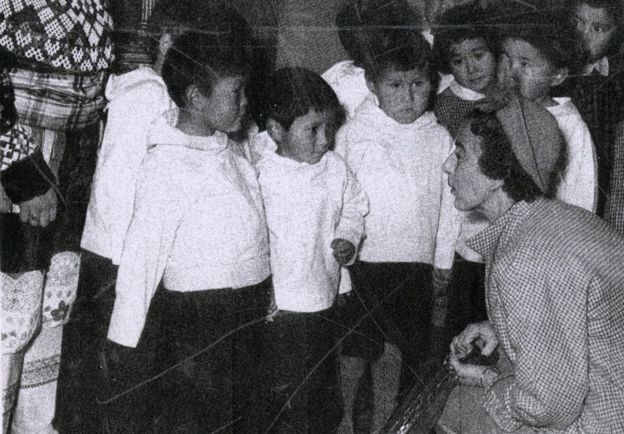
Queen of Denmark visits camp
The Queen of Denmark's visit
"I didn't understand a thing - I was incredibly upset and walked around looking very serious all the time," says Thiesen.
"You can see it in the photograph where we are all gathered round the Queen: none of us is smiling. Of course there were happier moments when we went to the beach and so on. But when they put us to bed at night, we cried quietly. I felt very sad and unsafe there."
Next, the children were sent to foster families around the country. In December 1951 a Danish weekly magazine ran a double-page spread on the experiment, proclaiming its success.
"The way of life here in Denmark is so different from what these children of nature are accustomed to but their ability to adapt is remarkable. Disagreements - caused by their reaction to civilisation - happen very rarely," it read.
"The children from Greenland already speak Danish quite well but when joy or anger makes them agitated, a flood of Greenlandic words suddenly gushes out and the sounds of gobbledegook are heard throughout the house.
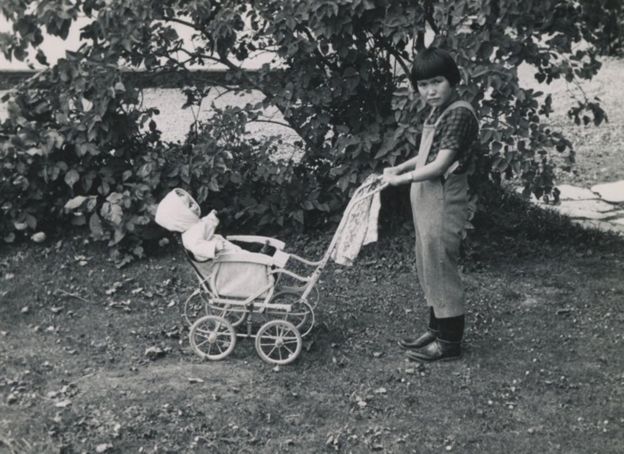
Helene Thiesen pictured at the home of her second foster family
Helene Thiesen at the home of her second foster family
"Helene has never said a word to her foster parents… and responds only with a nod or a head-shake when spoken to. But she's happy to chat away to her foster sister Marianne, who is teaching her how to knit."
Helene Thiesen had developed eczema at Fedgaarden and it was decided that she should live with a doctor. To treat her eczema, he covered her elbows and heels with a black ointment and forbade her from entering the living room so as not to ruin the furniture.
"I didn't feel welcome in that family. I just felt like a stranger. The mother had mental health problems and lay in bed all the time.
"As far as adults were concerned, I didn't trust them. They had sent me to Denmark. Whenever they said anything to me, I just nodded or shook my head. I didn't want to answer them."
A few months later, when her eczema was under control, Thiesen was moved to a different family.
"The second foster family was like a fairy tale compared to the first. They were very warm-hearted people," she says.
Then, the following year, 16 of the 22 Inuit children, including Thiesen, were sent back to Greenland. Save the Children had arranged for the remaining six to be adopted by their Danish foster families.
"When the ship docked in Nuuk, I grabbed my little suitcase and rushed down the bridge into the arms of my mum," says Thiesen.
"And I talked and talked about all that I had seen. But she didn't answer. I looked up at her in confusion. After a while she said something but I couldn't understand what she was saying. Not a word. I thought, 'This is awful. I can't speak with my mother any more.' We spoke two different languages."
And that's when she got another surprise. While Thiesen had been away, another charity, the Danish Red Cross, had built a children's home in Nuuk. It said that after their stay in affluent Danish homes, the youngsters shouldn't live with their own families in "worse conditions".
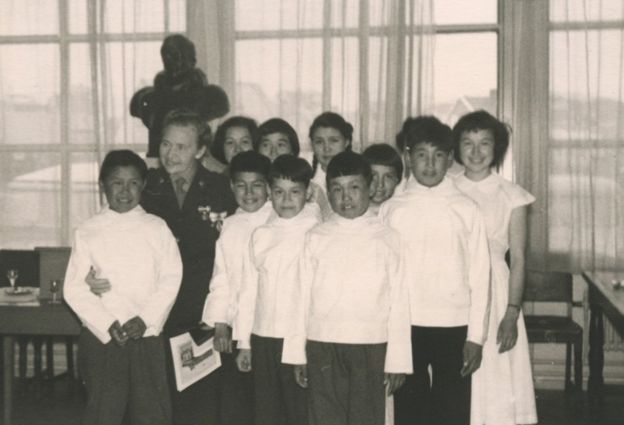
Helene Thiesen (back, third child from left) with other children in the home in Greenland
"Our new 'mum' - the director of the children's home - tapped my shoulder and said, 'Come on, get on the bus, you're going to the orphanage.' I thought I was going home to my mum. Why was I being sent to a children's home? No-one answered. I just got on the bus and could hardly see the town through my tears."
At the home, the children were discouraged from speaking the Inuit language. "We wanted to learn Greenlandic again because most of the staff working at the children's home were Greenlanders. And they couldn't speak much Danish.
"But then the Danish manager showed up and went, 'What are you doing? You can't teach them Greenlandic. These children need to be educated and to move up in society. So you'll only be speaking Danish to them in future.'"
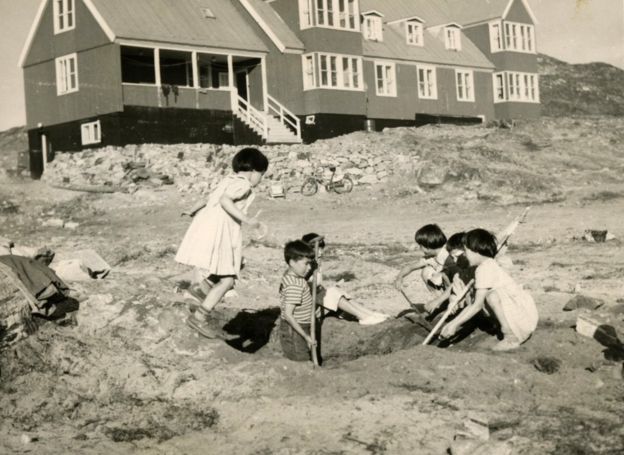
At the home in Greenland
The children play at the home in Greenland
Thiesen's relationship with her mother was never rebuilt. "I felt very bitter about her decision to send me away. Really angry that she had let me go, and not just that - that she let me stay in the children's home, even though we lived in the same town.
"It was in the days when Greenland was a Danish colony. And the colonial masters - they were 'masters' in the worst sense of the word - they controlled everything and you didn't contradict a Dane. You just didn't even question what they said."
Thiesen says the experience had long-term consequences.
"Throughout my life, I could never understand why I was often sad and prone to tears. When I first met my husband Ove in 1967, he almost gave up on me because I cried so much," she says.
It wasn't until 1996, when she was 52 years old, that she discovered why she had been taken away from her mother.
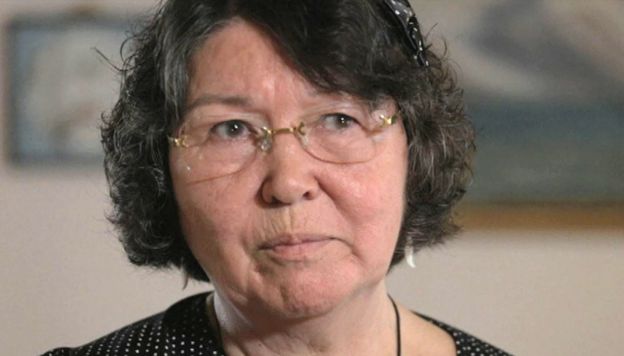
Helene Thiesen
Helene Thiesen: "We're devastated to have been part of this experiment."
The news did not come from the Danish government but from a Danish writer, who found a collection of documents in the Danish National Archives.
"She called me up and said, 'Are you sitting down? You've been part of an experiment.'
"I sat down on the floor and just wept."
On rare occasions, Helene and the other children meet, though she says only seven of them are left.
"We have all felt that this was wrong. We have felt a sense of loss and a lack of self-belief and those emotions haven't gone away," she says.
Far from serving as a model for cultural change in Greenland, the children ended up as a small, rootless and marginalised group on the periphery of their own society. Several of them became alcoholics and died young.
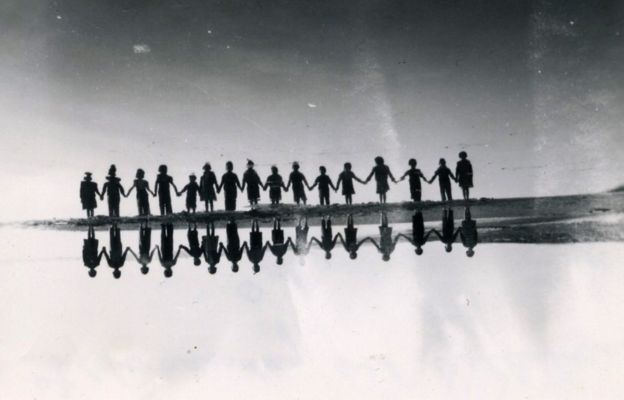
Children holding hands
"Some of them became homeless and some just broke down. They lost their identity and they lost their ability to speak their mother tongue and with that, they lost their sense of purpose in life," says Thiesen.
She received a letter from the Danish Red Cross in 1998 in which it said it "regretted" its role in the episode.
Finally, in 2009, Save the Children Denmark apologised too. But an internal investigation showed that some of the documents detailing the organisation's involvement have disappeared - Save the Children admits they could have been deliberately destroyed.
"When we look at what happened, it was a clear violation of children's fundamental rights. There's hardly a rule that hasn't been broken here," says Mimi Jacobsen, secretary general of Save the Children Denmark.
"Their well-being was set aside in favour of a project. They meant well, but it all went terribly wrong. I suppose the thinking at the time was that they wanted to educate and improve Greenlanders to give them a better future.
"They wanted to create role models so that they could return to Greenland and move that society on. That was the political thinking behind the project. And Save the Children were asked by the Danish state to help - which unfortunately we did."
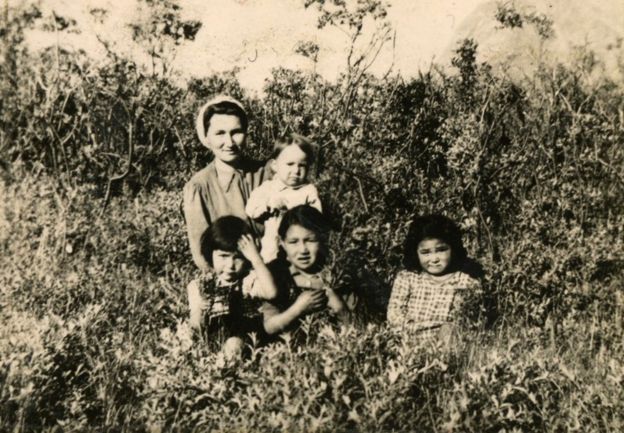
Helene Thiesen (bottom left), with her mother, siblings and a cousin
In 2010, the authorities in Greenland also called for an apology from the Danish government
The Danish Social Democratic party, then in opposition, agreed that should happen and called for an independent investigation. Then, after the party entered government in 2011 it went silent on the issue.
Thiesen says the experience did have some positive outcomes.
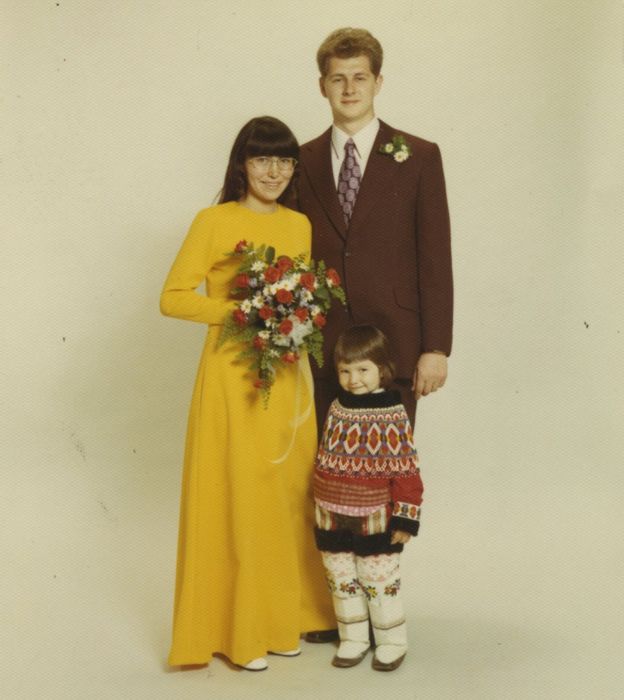
Helene with her husband and child
Helene on her wedding day, with her husband and child
"Despite the fact that I swore blind that I would never marry a Dane because I was furious with the colonial power, I ended up with a Danish husband. Together with him and my children, we have had a happy life in Denmark. And I became fluent in Danish, got a degree and a career."
Thiesen went into childcare and became the head of an after school club. Now 71, she is retired and lives in southern Denmark.
"But as far as the Danish authorities are concerned, I have felt very bitter and very disappointed. I've not been able to understand how they could turn us into an experiment. It's just incomprehensible and I'm still bitter about it. I will be until the day I die."

line

Greenland at a glance

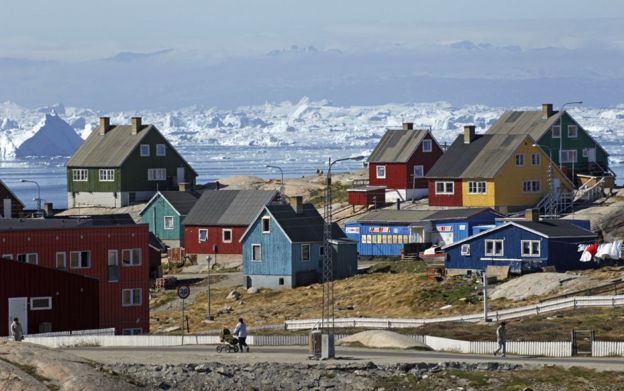
Ilulissat, Greenland
1721 A Danish settlement is established near present-day Nuuk and Greenland becomes a Danish colony
1940 The US assumes protective custody over Greenland during World War Two when Denmark is occupied by Germany
1953 Greenland becomes an integral part of the Kingdom of Denmark and obtains representation in the Danish parliament
1979 Greenland attains home rule following a referendum - its parliament decides upon and administers internal matters, but Denmark retains control over constitutional affairs, foreign relations and defence
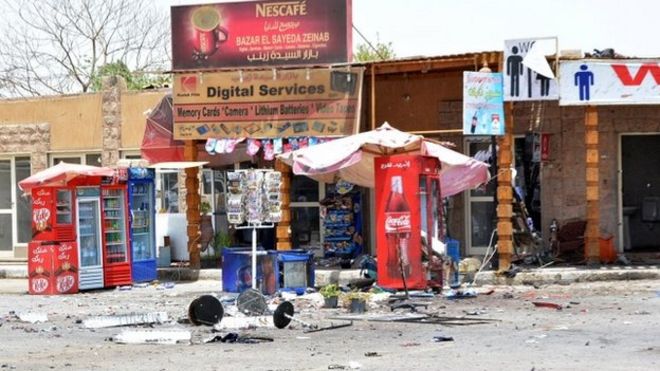
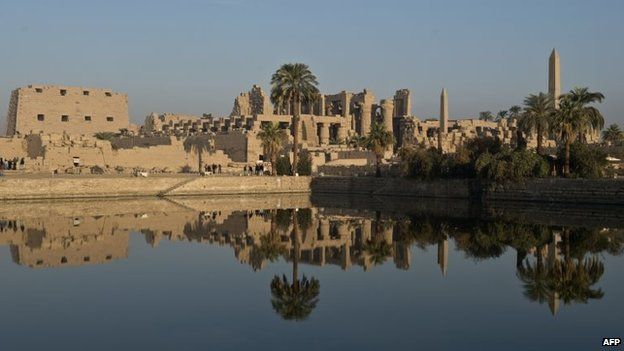
Suicide attack outside Karnak temple in Egypt's Luxor

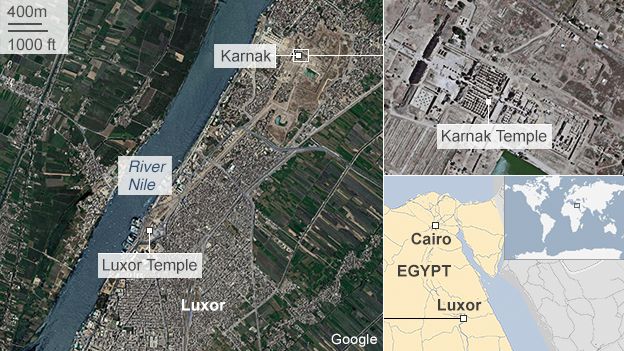
Police in Egypt say they have foiled an attempted suicide bomb attack at the Temple of Karnak in Luxor, one of the country's most popular tourist sites.
Three men reportedly approacDebris is seen near shops damaged during a foiled suicide attack in Luxor, Egypt, June 10, 2015hed a barrier at the entrance to the temple complex on Wednesday morning.
When confronted by police, one of the attackers detonated an explosive belt he was wearing. A second was shot dead and a third severely wounded.
Two civilians and two policemen were injured but no tourists were hurt.
The number of foreign tourists visiting Egypt has been increasing over the past 18 months, after slumps following the revolution that ousted President Hosni Mubarak in 2011 and the overthrow by the military of President Mohammed Morsi in 2013.

Karnak

Temple of Karnak complex in Luxor, Egypt (file)
  • Located on the east bank of the River Nile on the site of the ancient city of Thebes
  • Known to ancient Egyptians as Ipet-Sut ("the most select of places")
  • Covers more than 100 hectares (247 acres) and is one of the largest religious complexes in the world
  • Consists of the temples of the original local god Montu, and those of Amun, Mut and Khonsu, the Theban triad
  • Temple at Karnak may go back to the Old Kingdom (about 2613-2160 BC), but the earliest visible remains are of the Twelfth Dynasty (1938-1756 BC)
  • Complex contains a 30m (97ft) tall obelisk that weighs 323 tonnes
  • Second most visited tourist attraction in Egypt after the pyramids at Giza
Source: British Museum
line
There was no immediate claim of responsibility for the attack, but jihadist militants have killed hundreds of security force and government personnel since Mr Morsi, a member of the Muslim Brotherhood, was ousted.
After Wednesday's incident, Egypt's antiquities minister issued orders to increase security at tourist sites across the country, the official Mena news agency reported.
Map showing location of Karnak temple in Luxor, Egypt
Last week, two members of Egypt's tourism and antiquities police force were shot dead on a road near the pyramids at Giza.
In 1997, jihadist militants killed more than 60 people after attacking a group of foreign tourists visiting the Temple of Hatshepsut, across the River Nile from the city of Luxor near the Valley of the Kings.

Entrepreneur of the year: a Bedouin turned businessman

Don't ask Mohed Altrad how old he is. He may be a billionaire, but he doesn't know his age. No records. He's round about 65, perhaps.
Mr Altrad told me his astonishing story in the unlikely surroundings of one of the poshest hotels in that nest of posh, Monte Carlo.
Last year he was chosen as French Entrepreneur of the Year. The other day he went to Monte Carlo and - out of 52 national award winners - won the title World Entrepreneur of the Year in the annual contest organised by the international business services giant Ernst and Young.
An extraordinary rags to riches journey. He told me about it. Mohed Altrad speaks considered English, slowly, fluently. He doesn't sleep much. He thinks a lot and writes a lot. About that past of his, and his present.
Mohed Altrad was born in the Syrian desert, a Bedouin. His father was the leader of the tribe. His mother was poor, disregarded. His father raped his mother, twice. The result of this impulsive relationship: two sons. Mohed Altrad's elder brother died, killed by his father.
His mother died on the day he was born.
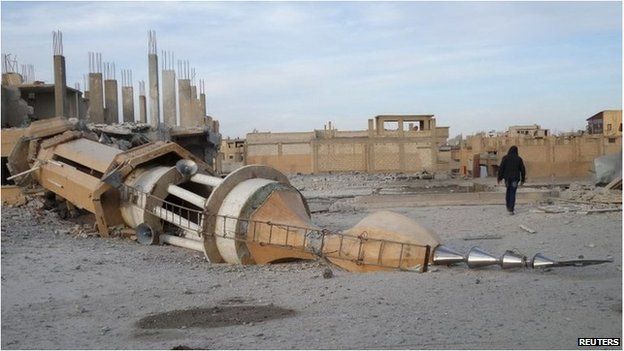
People inspect a mosque in Raqqa after it was hit in what activists said was a Syrian government air strike on 25 November 2014
Mr Altrad spent part of his youth in Raqqa, Syria, now an ISIS stronghold
He was brought up by his grandmother in poverty. She assumed he would be a shepherd. No need for school. But the curious boy was intrigued when he saw the others were being taught. He peeped into the class through a crack in the wall and glimpsed calligraphy on the blackboard, something of course, that he could not understand.
Eventually he persisted and got to the school. He was a clever boy; he did well. So well that his classmates revolted when the shepherd boy came out top of the class. They carried him off and dug a hole in the desert, shoved him into it head first and and ran off.
Somehow Mohed Altrad wriggled out, and escaped. "The instinct of life," he calls it. And his luck began to turn. A childless local couple took him under their wing. He went to school, did well. In Raqqa, the city that is now capital of the ISIS, the Islamic state, a takeover that saddens him.
Sixty years ago the position of Syria was also complicated: a military dictatorship under the influence of France and the Soviet Union. Mr Altrad won a place at a university in Kiev, only to be told the course was full.
Instead he was sent off to one of the oldest universities in Europe, Montpellier in France. He arrived late one chilly November evening, not knowing any French.
But that did not hold him back for long. Eventually he got a PhD in computer science. He worked for some leading French companies, became a French citizen, and then worked for the Abu Dhabi National Oil Company, where there was nothing to spend his earnings on. He saved money.
He itched to be in charge of his own destiny. Back in France he co-founded a company making portable computers...suitcase-sized, he says. When it was sold, he had more capital.
Eventually Mr Altrad and a partner bought a small French scaffolding business. For one franc and lots of liabilities. It was bleeding money.
Not high tech, but scaffolding is always needed, he thought. And the small contractors buying or renting his steel poles also needed wheelbarrows and cement mixers. Another leg for the business.
The new owners turned it round, incentivising staff with performance bonuses. It started generating cash.
Mr Altrad used the money to expand, by buying other companies in what was a fragmented, local industry undergoing widespread consolidation. He tried to treat his employees well, asking them to respect a sheet of principles they were shown when they joined the firm.
He began to expand abroad, sticking to the same business and to similar principles. He added to scaffolding the things builders needed. And over 30 years, this small business grew to encompass 170 companies under the Altrad umbrella. Seventeen thousand people, $2bn (£1.3bn) turnover, $200m annual profit.
He has just doubled the size of the company by buying a Dutch rival.
Mohed Altrad
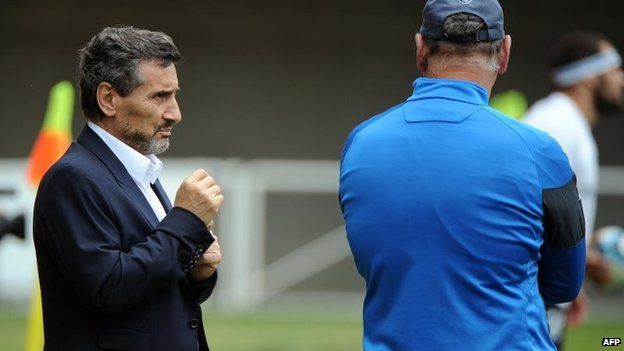
Mr Altrad is president and part owner of the rugby team in his adopted home: Montpellier
Despite the fact that he had such success, and won such acclaim, Mohed Altrad remains a quiet and thoughtful leader.
"You can ask why I am doing this," he says. "It has never been for money. I am trying to develop a humanistic venture to make the people who work for me happy."
"If they are happy, they are more efficient, better performers, they have a better life." That—he says—is what companies ought to aim for. "If I am happy, I work well."
Mohed Altrad believes in financing business growth out of cash flow. "If you go to the financial markets," he says, "you are a prisoner of the banks. We reinvest our earnings."
Altrad, the company, has been taking part in a great consolidation of a very fragmented, locally-based industry. Even so, it strives not to behave as a monolith.
"A company is an identity, a piece of history; its products, clients," he says. "The general tendency of big groups like us is to reshape [the companies they buy] and make them more or less standard. This is absolutely against my concept." So Altrad companies keep their own names, and their own identities.
But there is what Mr Altrad calls a charter of shared values for all the companies, which new recruits are asked to read, subscribe to... or improve. "It's a human venture," he says.
"If you are interested in a woman," he told me, "and your first reflex is to say don't dress like this, don't use this make-up, then what are you doing? It is precisely the same thing when you buy a company."
He uses his sleepless nights to write books... some of them about economics. He has also written an autobiographical novel; Bedouin is how the title translates into English.
It has been chosen by French education officials to be read in schools, in millions of copies. His story goes on having resonance in a Europe where immigration is a big issue.
"I am here in front of you," he said to me, "but you can say I have a life of three thousand years. This life of the desert, it has its own rules, which started 3,000 years ago. Talking to you here in this nice place, to me it's very strange to do that; that [feeling of strangeness] is in my blood, in my everyday life."
Mohed Altrad is always aware that something (like being buried alive in the desert) can happen, always a bit scared. "So this feeling of freedom is always here as well," he says.
I asked him if he was now happy. Not really, he says.
"I have a debt in life that I know I will never be able to reimburse. This is to give life again to my mother who has no life. She had a very short life... 12 or 13 years. She was twice abused. She saw her son die. She died immediately the day I came."
To keep the spirit of his mother alive is the extraordinary motivation of Mohed Altrad, Entrepreneur of the Year.
Peter Day's interview with Mohed Altred will be broadcast on Global Business on the BBC World Service on 11 June.

Paedophile priests: Pope Francis set up tribunal

Pope Francis has approved the creation of a Pope Francis leads a mass at Saint John's Lateran Basilica in Rome - 4 June 2015tribunal to hear cases of bishops accused of covering up child abuse by paedophile priests.
The unprecedented move followed a recommendation from the Pope's newly-created panel on clerical sex abuse.
Victims' groups have long called for the Vatican to do more to make bishops accountable for abuse on their watch.
Last year, the UN strongly criticised the Vatican for failing to stamp out child abuse and for allowing cover-ups.
A statement from the Vatican said the department would come under the auspices of the Congregation for the Doctrine of the Faith.
Its aim would be "to judge bishops with regard to crimes of the abuse of office when connected to the abuse of minors", the statement added.
The Vatican panel which recommended the step was created to help dioceses improve abuse prevention measures and help victims.

Vietnam's War Babies

Sophie English could walk past her mother in the streets of Ho Chi Minh City at any moment and not even know it.
Born during the Vietnam war, Sophie was just 10 months old when she was sent to Australia. One of thousands of Vietnamese children adopted by overseas families, she has suffered the pain of not knowing her birth family and culture.
More than four decades later, 101 East joins Sophie as she returns to her homeland in search of her birth mother and a sense of belonging. What she finds is a new generation of Vietnamese orphans hoping for a better life.
Join the conversation @AJ101East
Source: Al Jazeera

The Day Israel Attacked America

In 1967, at the height of the Arab-Israeli Six-Day War, the Israeli Air Force launched an unprovoked attack on the USS Liberty, a US Navy spy ship that was monitoring the conflict from the safety of international waters in the Mediterranean.
Israeli jet fighters hit the vessel with rockets, cannon fire and napalm, before three Israeli torpedo boats moved in to launch a second more devastating attack. Though she did not sink, the Liberty was badly damaged. Thirty-four US servicemen and civilian analysts were killed, another 171 were wounded.
Later Israel apologised for what it claimed to be a tragic case of mistaken identity. It said that it had believed the ship to be hostile Egyptian naval vessel. US President Lyndon Johnson was privately furious but publicly the White House chose not to challenge the word of its closest Middle East ally and accepted that the attack had been a catastrophic accident.
However, as this exclusive Al Jazeera investigation reveals, fresh evidence throws new light on exactly what happened that fateful day - and the remarkable cover up that followed.

FILMMAKER'S VIEW
By Richard Belfield
I was first told about the attack on the USS Liberty in 1980 over dinner with a former analyst from the National Security Agency (NSA) in Washington DC.
Back in 1980, I promised my friend that if I ever got the chance I would make a film about it. Over the years, I pitched the idea to numerous broadcasters and always got the same response: eyes rolled upwards, usually followed by the statement, "Are you completely mad?"
Fast forward to 2009 and I was a guest speaker at the NSA's biennial conference on historical cryptography, talking about an unsolved code on an 18th century monument in an English stately home.
While there, I went to two other sessions - both about attacks on American signal intelligence naval vessels.
The first was the capture of the US spy ship, the Pueblo (boarded by North Korean forces in 1968 - and never returned). The survivors of that incident were treated like heroes and feted on stage.
The next day there was a session about the USS Liberty. James Scott, who has written easily the best book on the Liberty attack, was on stage and limited to his allotted 20 minutes. Ranged against him were three Israeli apologists, all of whom were allowed to overrun their time. Survivors from the Liberty affair were allowed to sit in the audience, but they were denied any say in proceedings.
As an Englishman, I was brought up with a strong sense of fair play and I thought this was a disgrace. It was gruesome to watch. First, the crew had been attacked in broad daylight by a close ally, then they were betrayed by their government and now they were being humiliated by the same agency many had worked for back in 1967.
Earlier this year, I acquired a copy of the audiotape of the attack as it had unfolded, the real time conversations between Isreali Air Force pilots and their controllers back at base. It had never been broadcast before. I went to talk to Al Jazeera and after careful consideration, the network commissioned the film.
On location, it all started with James Scott (who gets a co-producer credit on this project). When writing his book, he had already interviewed the survivors as well as many of the key people in the Washington political and intelligence machine from that time. The introductions he made would prove invaluable as we began filming interviews.
The veterans were extraordinary. One after another, they were generous with their time, uniformly eloquent and passionate and above all, honest in their recollections.
They all felt betrayed by the American government but were keen to exonerate ordinary Jewish people both in Israel and without, for any responsibility for the incident. Their beef was simply with the senior Israeli officers in the control room and their superiors higher up the command chain who had ordered the attack.
After a few days filming, I rang Elaine Morris, my producer back in London. She asked how things were going. All I could say was that the quality of the interviews was the best I had ever experienced in many decades in this business.
In Texas we interviewed Bobby Ray Inman, an intelligence officer with a glittering track record at the CIA, Naval Intelligence and as a former director of the NSA. My contacts in the UK intelligence world had always told me "he is one of the good guys" and I quickly discovered why. He was frank and clear. The top Israeli commanders, he explained, had known exactly what they were doing when they attacked the Liberty and when it came to holding them to account, the US government rolled over for them.

We filmed an annual memorial ceremony in Washington, D.C. It was emotional, visceral and tense, with survivors, family and friends gathered in the morning sun. Listening to a sole bugler playing the US Navy's lament, 'Taps' is a memory that will never fade.
Years earlier, I had visited the US military graves in Arlington Cemetery but now, following the ceremony, I got to go there again with Dave Lucas, one of the survivors of the attack and a truly wonderful man.
We filmed as he walked up the hill carrying a wreath from the ceremony. Alongside him was a crew member, a Portuguese language specialist, who had left the Liberty in Spain just a few days before it sailed off up the Mediterranean to take up position off the Egyptian coast. He had been temporarily replaced for the mission by an Arab linguist. He wept openly for the comrades he had said goodbye to, never to see again. As we filmed the pair laying the flowers, an interview with one of the other survivors, Jim Kavanagh came suddenly to mind. "I went through hell," he had said about his shipmates. "But they left this earth."
Finally, we filmed on a sister ship to the Liberty, now moored in San Francisco. The crew hauled an outsized US flag up a mast for us. The flag - known as the "holiday colours" - was identical to that which was flown from the Liberty on June 8, 1967. It was huge, clearly visible for miles, and I knew immediately that no one could ever have been in any doubt about the nationality of the ship beneath it.
Watching the Stars and Stripes unfurl into the wind, I realised that I had got to keep the promise I first made to my friend in a Washington restaurant 34 years ago. 
Source: Al Jazeera