Thursday, August 27, 2015

Magazine: Documenting America's white nationalists

A photographer followed members of the National Socialist Movement for a year, until her project came to a dramatic end.

National Socialist Movement members and their families get organised in a hotel lobby before marching on the street in front of the Mexican consulate in Las Vegas. June 2010 [Julie Platner]
I first met Jeff Hall in a supermarket parking lot 11 miles southeast of downtown Los Angeles. I had driven there in a beat-up Dodge pickup I'd borrowed in the hope of blending in, and immediately noticed the tall, dark-eyed man pacing back and forth as he spoke on his mobile phone. A large Iron Cross tattoo adorned the back of his clean-shaven head.

I braced myself as I approached. "Hi, I'm the photographer," I said. He looked towards me without making eye contact and mumbled something about needing to wait for the other media. Then, with a faint smirk, he said: "Nice truck. I'm driving around in my wife's crappy little piece of shit."
I spent the next year documenting the Detroit-based National Socialist Movement (NSM) of which Hall was a member. I wanted to get a first-hand glimpse of a group organising around the ideals and rhetoric of white nationalism in a US nowhere near entering the 'post-racial' epoch many hoped would be ushered in by Barack Obama's election.
Hall was the NSM's West Coast Unit leader. An unemployed plumber and father of five who bought his family's groceries with food stamps, he was charismatic and politically active in his community; once running for office with Riverside California's Western Municipal Water District and securing 33 percent of the vote.
From the supermarket parking lot, Jeff led me, a two-person crew from HBO and members of a local television station, to a motel just down the road where 25 or so NSM members had gathered. These were the members who had travelled from out of state. Some sat in their rooms with the doors open; others hung over the railing of the second floor walkway running along the back of the building. There were a few women and a handful of teenagers.
The other media professionals took a few pointed interviews and left. Then the atmosphere grew progressively more relaxed. A large guy covered in tattoos made a run for beer, Fox news played in the background and members drifted into different rooms. I tried to make myself as invisible as possible and spent the afternoon and early evening photographing them.

'Start nothing, finish everything'
National Socialist Movement members try to protect themselves from rocks and glass being thrown by counter protesters as they leave their rally on the steps of Los Angeles, City Hall. April 2010 [Julie Platner]
The following morning, the NSM congregated in the motel foyer in preparation for a march to the steps of the Los Angeles City Hall to protest against illegal immigration. The mood was militaristic, intense and starkly different to that of the previous afternoon.
The leader of the group spoke, encouraging everyone to put their best foot forward. Dressed in German Nazi uniforms, they all seemed to stand a little taller, their backs a little straighter. Hall urged them to "start nothing and finish everything" as though preparing for conflict.

Escorted by dozens of police officers, the group marched to the steps of the hall. Streets were blocked off and a 100-foot deep security perimeter set up.

As the NSM approached they were greeted by hundreds of angry counter protesters who outnumbered them by at least 40 to one. Members of the group stood on the steps and took turns at the microphone, yelling their messages about the "illegals that were coming over the border living on welfare and taking our jobs".

I overheard a few passersby quietly approving of their efforts, including a 45-year-old white man who encouraged them to "keep up the good work".

'Everything seemed normal, apart from the swastika' 
Corey shows his tattoo of a Confederate flag to one of Jeff Hall's daughters, who is herself holding a Confederate flag that she was given as a prize for winning a game played at her mother's baby shower [Julie Platner]
Later that year, I called Hall from my home base in New York. Eager to be invited into his home in Riverside, an exurb of Los Angeles, I asked about the monthly meetings he held there. He told me that they were planning to hold a baby shower for his wife Krista, a 20-something-year-old elementary school teacher, after the following month's meeting.

When I asked if I could come, he chuckled and said: "You want to?"
As I walked into the Hall family home - a standard American tract house, owned by Jeff's mother - my first impression was how very normal it seemed. The layout reminded me of the condo I'd shared with my mother and younger sister many years before.

Pink stickers bearing the words 'I love you' adorned the sliding glass door leading to the backyard. It wasn't long after Christmas and decorations still littered the house. There were baby shower presents on the floor of the formal living room.

Everything seemed normal; everything apart from the large swastika flag hanging from the ceiling of the family room.
Through the pink heart-decorated glass slider I could see Krista hopping around like a bunny rabbit in the backyard. Three little girls hopped behind her, smiling.
'King of his castle'
Jeff Hall’s wife Krista takes a picture of Nacional Socialist Movement members as they chant and make Sieg Heil gestures in the backyard of her home in Riverside, California. The couple's youngest daughter sits and draws with chalk as she watches [Julie Platner]
During lunch, the oldest of Hall's children, 10-year-old Joseph, took three or four chocolate chip cookies from a packet on the counter. Hall ran after him, grabbing the cookies from his son's hand. There was a momentary struggle, from which Joseph quickly receded. A look of terror briefly flashed across his face. The interaction seemed like something you might expect between siblings.
When it was time for the meeting to begin, Hall opened it by slamming then US Secretary of Homeland Security Janet Napolitano and her recent commentary on how the country's borders were secure. He spoke about the importance of the NSM border patrols, attendance and recruitment.

He mentioned that even his son had begun to join him on armed border operations in California and Arizona - operations designed, as Jeff put it, "to defend our nation from the invasion from Mexico". Most importantly, he felt, they would keep immigrants from taking any more American jobs.
Leadership in the NSM offered Hall an escape from the reality of his life and its disappointments. It gave him an opportunity to blame his woes, not on an elusive broken system but on a tangible enemy: the brown and black people 'taking' from the whites.
Recently, I had the opportunity to speak on the phone with Michael Kimmel, the author of the book Angry White Men: American Masculinity at the End of an Era. He described the thought pattern of Hall and others who share his views: "Since I've lost my sense of entitlement in the work place, I will become a mini-tyrant at home; I will become king of my castle. This effectively gives him something to be proud of, something that demands respect."
Kimmel continued: "They are angry, and rightfully so, that something they were promised no longer exists. They have been blindsided; brought into a system that doesn't work anymore."

Someone to blame
Jeff Hall shows another National Socialist Movement member how to pull a knife from his waist band as they prepare for a nighttime patrol along the US-Mexico border in Arivaca, Arizona. They intended to set up listening posts and hoped to catch immigrants crossing from Mexico. August 2010 [Julie Platner]
According to US News and World Report, "there are roughly 5.1 million fewer American manufacturing jobs now than at the start of 2001".
A lack of jobs in the US is creating a desperate situation for the middle and working classes. And, the populace watching corporate right-leaning media is being delivered a specific message about who is to blame.
All one has to do to witness this is to tune into the highest rated syndicated radio show in the country, to hear Rush Limbaugh saying things such as: "The days of them not having any power are over …. And, they want to use their power as a means of retribution. That's what Obama's about, gang. He's angry, he's gonna cut this country down to size, he's gonna make it pay for all the multicultural mistakes that it has made, its mistreatment of minorities."
This type of mainstream media pundit rhetoric leads many Americans to frame their economic woes as displacement by minorities and immigrants. But, there is a far greater, more universal predicament: a vicious class divide squeezing all levels of society other than the very wealthy.
The end
Ten-years-old Joseph Hall sits on the stairs of his family's home eating a sandwich while surrounded by members of the National Socialist Movement. April 2011 [Julie Platner]
My next trip to the Hall family home on April 30, 2011, was also my last. Hall's children played in the backyard and ate sub sandwiches as I took photographs of them.
The very last image I took in the house, that Saturday afternoon, was of blond, blue-eyed Joseph sitting on the stairs, his shoes so small for his growing feet that his toes poked through. Next to him stood an NSM member in his black, steel-toed combat boots.
After we all left that evening, Hall and his friend Butch drove another NSM member home to San Diego. Hall returned a few hours later, drank whiskey and fell asleep on the worn, beige sofa.

Some time after that, Joseph, who was supposed to be sleeping beside his four younger sisters, aged from three months to nine years old, made his way downstairs. He approached his father with a raised Rossi .357 magnum handgun, and pulled the trigger.

The bullet entered a few inches behind Hall's ear, killing him instantly.


'To start all over'
Jeff Hall and other members of the National Socialist Movement are transported by prison buses to a rally in New Jersey. The state police requested that NSM members park their cars at the state police barracks and be transported via the buses in order to minimise the likelihood of clashes with counter protestors [Julie Platner]
At around 11 the following morning, I received a call from Butch: "I'd just like to let you know, since you were just at the house with us, yesterday… that Jeff is dead."

He continued: "I just drove to his house to bring a box of doughnuts. That's what I do on Sundays. There was police tape blocking off the cul-de-sac. I asked the neighbour who was standing outside. She told me that Jeff had been shot. I don't know anything else. I left … I don't want to talk to the police."
Joseph was taken into custody that morning. He said that his father had threatened to kill the family. "He said he was gonna turn off the smoke alarms and burn the whole house down when we were asleep …. That really scared me."

He said that he was afraid that "dad was going to do something that would make mum go away. I didn't want my mum to leave … dad was kinda mean. So I thought maybe it would be him to leave."
When the detective pressed Joseph to see if he understood what he had done, the 10-year-old answered: "I wasn't really thinking about if he was gonna die or get unconscious … I was trying to get him to know how I feel when I get hurt …. Then maybe we could go back to being friends and start all over."
Ironically, the harm that befell members of the NSM came mainly from within. Jeff Hall's life was not the only one that ended violently that year.

A few months after Hall died, a friend of his and fellow NSM member, Norm, took his own life. Then, almost exactly a year later, another member, J.T. Ready, killed his 47-year-old girlfriend, her daughter and infant granddaughter, the daughter's fiancé and himself.
This article first appeared in the November 2014 issue of the Al Jazeera Magazine. For more compelling stories, download the magazine for iPads and iPhones here, and for Android devices here.
Source: Al Jazeera

Race in the US: Know your history

"And then you might understand how the death of Michael Brown became a tipping point in the US."

An African American woman yells 'Freedom' when asked to shout so loud it will be heard all over the world at the March on Washington in August 1963 [Express Newspapers/Getty Images/File]
There will never be an acceptable explanation for what happened between Michael Brown and Darren Wilson in Ferguson but we will never fully grasp why the stage was set for such an encounter unless we know American history.
We cannot fully comprehend why Dylan Roof murdered nine parishioners at Emanuel AME Church in Charleston unless we study the Civil War and the Confederacy.
We cannot truly fathom how a minor traffic stop in Cincinnati could result in a white campus police officer blowing out the brains of an unarmed black man unless we delve into the role race has played in law enforcement from the enactment of the federal Fugitive Slave Act in 1850 to today's mandatory minimum sentencing statutes.
Examining American history provides us with the tools to analyse how the death of Michael Brown and the demonstrations on Florrisant Avenue became a tipping point and sparked a movement. Connecting the dots between the past and the present helps us to see the origins of our current national debate - about race, police misconduct, white supremacy, white privilege, inequality, incarceration and the unfinished equal rights agenda.
The pendulum
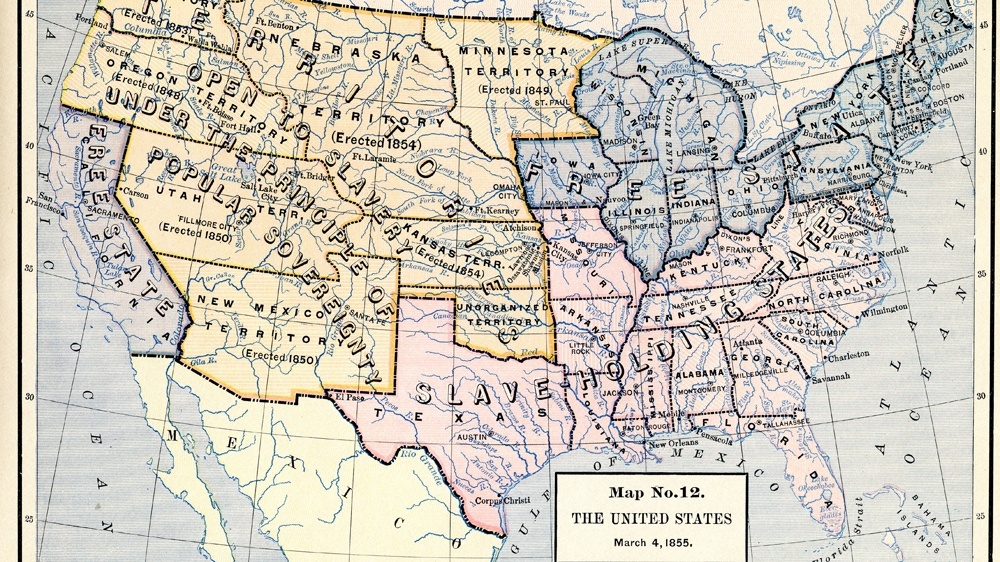
A colour-coded map illustrates the 'Free States,' 'Slave Holding States,' and 'Territories Open To Slavery Under The Principle Of Popular Sovereignty,'. It was published in 1898 [Getty Images]
The history of people of African descent in America - which is to say the history of America - is a pendulum of progress and setbacks, of resilience and retaliation, of protest and backlash. There have been allies and there have been opponents. There have been demagogues, who would divide Americans on the basis of colour and class, and visionaries who would seek to lead us to common ground.
Image Map
The quest for "life, liberty and the pursuit of happiness" has been an American aspiration since the Declaration of Independence, but black Americans, Native Americans and women were not at the table in 1776. Forty of the 56 signers owned other people.
Lest there be any doubt about where the young nation's sentiments lay, the Supreme Court's 1857 Dred Scott decision made clear that people of African descent - whether enslaved or free - would not be considered American citizens and had no legal standing in the courts. It mattered not that some of their grandfathers had served in George Washington's Continental Army during the Revolutionary War.
Last month in Washington, DC, at the third annual March on Washington Film Festival, Dr Clarence B. Jones, a confidant and personal legal counsel to Dr Martin Luther King, Jr., said "a definitive discussion and description of the institution of slavery, the concomitant supporting ideology of white supremacy and the impact it has had on subsequent generations" are missing from the history curriculum of most American high schools and colleges.
Without that knowledge, he said, it is impossible to understand America today.
"Our history has never taught the centrality of race as the key barometer to how well we are doing with the American Experiment," added Pulitzer Prize winning historian Taylor Branch that same evening. "If you don’t have race at the forefront of an investigation of how America is fulfilling its goals, then something is wrong. And unfortunately right now we are paying the price for 50 years of trying to avoid and hide that subject."
Indeed every time we see another video - of Sandra Bland, of Freddie Gray, of Tamir Rice - we witness the horrifying evidence of our national failure to confront this legacy.
What used to be called 'the Negro problem,' really is a matter of the intransigence of white supremacists who are mired in the past.
Slavery was not the benign, paternalistic system described in the history textbooks of my youth. Instead it was a brutal, often sadistic, form of domination over the bodies and minds of people who were kidnapped, whipped, beaten and raped. Generations of human beings toiled against their will without pay or legal rights.
For 246 years - from 1619, when 20 Africans were forced into indentured servitude in Jamestown, Virginia, until the end of the Civil War in 1865 - most people of African descent in America were enslaved. Those who had purchased or otherwise been granted their freedom lived a precarious, circumscribed existence.
Slavery and the slave trade were essential to the American economy and to the development of American capitalism, especially after Native Americans were driven off their ancestral land in the Deep South in the 1830s to make way for vast cotton plantations. The wealth of the nation was inextricably dependent upon uncompensated labour, which enriched not only the planters, but universities, banks, textile mills, ship owners and insurance companies, who held policies on their bodies. To settle a debt, an owner merely needed to sell one of his slaves.
By 1850, enslaved Americans, who were listed in their owners' inventory ledgers alongside cattle and farm equipment, were worth $1.3bn or one-fifth of the nation's wealth. When the first shot of the Civil War was fired at Fort Sumter in April 1861, the value of that human collateral exceeded $3bn and was worth more than the nation’s banks, railroads, mills and factories combined. Now numbering four million souls, they were, as Ta-Nehisi Coates has written, America's "greatest financial asset".
Immediately after the Civil War during the hopeful, but brief period of Reconstruction, black people were finally recognised as citizens with rights. But just as quickly as the 13th, 14th and 15th amendments abolished slavery, provided equal protection under the law and granted black men the right to vote, Reconstruction ended with retaliatory Redemption.
When federal troops abandoned their posts in the South after the Compromise of 1877, the defeated Confederates regrouped as the Ku Klux Klan and the Knights of the White Camellia. They regained control of their workforce not by owning them but by circumscribing their lives through terror, violence and voter suppression.
In Louisiana, the number of registered black voters plummeted from 130,334 in 1896 to 5,320 in 1898. Fraudulent voting schemes pushed black elected officials from state legislatures and from Congress. During the late 19th century, there were 20 black members of Congress . When North Carolina's George Henry White left in 1901, there would not be another until 1928, when Oscar DePriest was elected in Chicago . For virtually the first half of the 20th century the 15th Amendment had no value for blacks in the former Confederate states, where they were denied the right to vote through the cynical artifice of poll taxes, literacy tests and grandfather clauses.
Jim Crow laws and Black Codes obliterated Reconstruction wins and codified racially based discrimination. The sharecropping system, which left black farmers in debt at the end of every harvest, was equivalent to slavery. Black children were allowed to attend school only during times of the year when there were no farm chores to do. Historian Rayford Logan called the period "nadir of American race relations".
Those who got too uppity were lynched, firebombed in their homes and chased from land they owned.
In 1915, D. W. Griffith's technically groundbreaking movie, Birth of a Nation , glorified the Klan and fed the trope of black inferiority and criminality. Around the same time, a migration wave began that would eventually see more than six million black Americans flee the brutality and deprivation of the South for the relative freedom of the North and the West.
Four years later, when black soldiers returned from World War I military duty in France, they were attacked during the 'Red Summer' as resentful whites instigated riots in at least 34 cities, from Chicago and Washington, DC to Memphis and Charleston. Their goal was to put men who had received France's Croix de Guerre back in their place as the Klan had done after Reconstruction. The NAACP investigated and black newspapers editorialised. During the succeeding decades - through the Depression, the New Deal and World War II - the pendulum continued to swing between progress and setbacks.
The attitudes that informed Jim Crow laws and discriminatory public policy existed in the North as well as the South. The results are evident today in major American cities, where banks refused loans to black home buyers in the 1950s and 1960s, literally drawing on maps red lines around predominantly black neighbourhoods and ensuring that those homes would not appreciate in value at the same rate as comparable white neighbourhoods.
In 1957, when my parents were ready to finance a new home in an all-black development of newly constructed residences in a suburb of Indianapolis, they were unable to secure a loan from any of the city's large banks. Both were college graduates and business executives. Our neighbours were doctors, teachers, coaches, plumbers, entrepreneurs, realtors, nurses, ministers, architects, insurance salesmen and carpenters. Many of the men were veterans of World War II and the Korean War and therefore eligible for the GI Bill's home loan guaranty. In other words, people who normally would have had no trouble qualifying for mortgages. Instead, they went to Mammoth Life Insurance, a black-owned insurance company then based in Louisville, Kentucky, for their loans.
In 1954, the Supreme Court's Brown v. Board of Education decision struck down so-called separate but equal education and mandated that American schools be racially integrated.  As a post-Brown v. Board child, I always attended integrated schools, encountering the occasional racist, but, like my parents, rolling with the punches, keeping perspective and finding progressive kindred spirits in the process. But in many communities - both in the South and the North - the diehard segregationists responded with paranoia and bitterness, decrying the evils of race-mixing and miscegenation. 
In 1957, nine students at Little Rock High School were harassed and spit upon. In 1963, Alabama governor George Wallace tried, but failed, to block the enrollment of Vivian Malone and James Hood. Across the South, federal troops were called in to facilitate the process.
For a time it seemed that American schools might be integrated, but that pendulum soon began to move in the other direction as all-white academies opened. Today, most Americans are enlightened enough not to oppose interracial marriage and are much more tolerant than their grandparents and great-grandparents, but American public schools in most areas are more segregated than ever, as Nikole Hannah-Jones' April 2014 ProPublica investigation of Tuscaloosa, Alabama schools so well illustrated.
Pressure from Martin Luther King, Jr., Fannie Lou Hamer, thousands of activists and a powerful cadre of civil rights leaders combined with the political muscle and willingness of the Kennedy and Johnson administrations to push for critical legislation during the mid-1960s. The Civil Rights Act of 1964 forbade discrimination on the basis of sex as well as race in hiring, promoting and firing. Today, our workplaces are undoubtedly more diverse than they were in the 1950s, with more people of colour employed as physicians, firefighters, attorneys, journalists, investment bankers and professors. But it is still true that when a white person and a black person with comparable credentials apply for a job, the white person is more likely to be hired.
The Voting Rights Act of 1965 outlawed poll taxes and made it possible for thousands of formerly disenfranchised black Americans to vote. Now, throughout America, there are thousands of people of colour who are city council members, mayors, members of Congress, on school boards and of course, now in the White House. During the last two presidential elections, black voters turned out in record numbers because they were motivated and because many of the old obstacles to voting had been removed.
But a backlash has developed in that arena, too. Two years ago, in Shelby County v. Holder, the Supreme Court gutted Section 5 of the Voting Rights Act, removing the 'preclearance' provisions that required states   with a history of voter discrimination to seek permission for changes to electoral procedures. Despite no evidence of significant voter fraud, Republican legislators immediately passed new voter ID laws  that groups like the Brennan Center for Justice and the Advancement Project argue will suppress voter turnout among black, Latino, elderly and young voters, who are more likely to vote for Democrats.
President Barack Obama's election in 2008 and re-election in 2012 provided evidence of how much the nation has changed in the last half a century . While arrival of the 'post-racial' era was much overstated and a result of magical thinking, Americans rightly celebrated the progress on Inauguration Day 2009 . The high of the moment, though, was accompanied by the rise of the Tea Party and the reminder of the strain of white supremacy that is baked into the American DNA.
Rattled by the presence of a black family in the White House, 'birthers' emerged and fabricated a myth that America's first black president - by some amazing feat of molecular transference - had been born not in Hawaii, where his mother was located at the time, but in Kenya. In this age of social media, Youtube and cable television, their illogical stories took flight, promulgated not just by the poorly educated prone to conspiracy theories, but by people who clearly knew better.
When the past isn't past
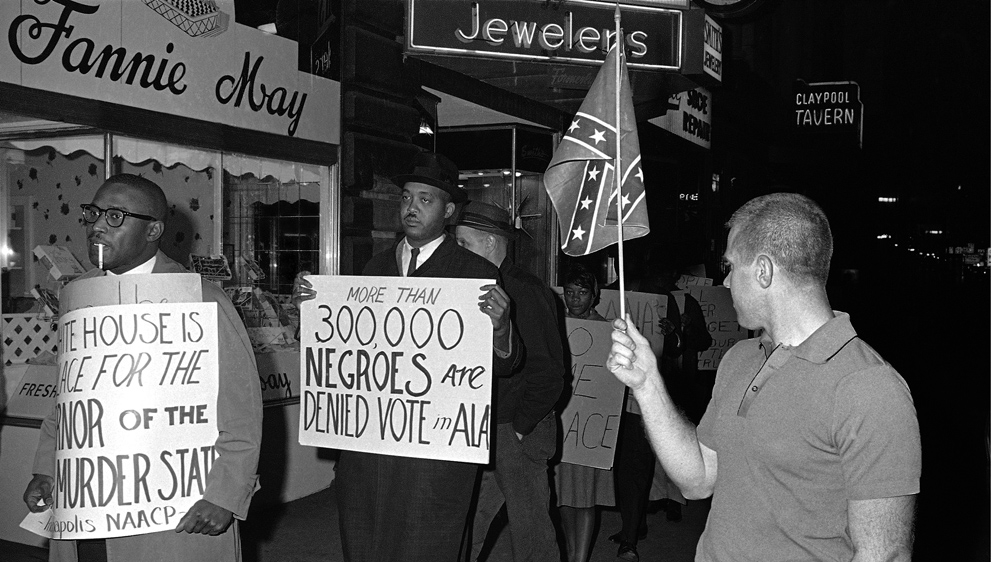
A man holds a Confederate flag as demonstrators, including one carrying a sign saying "More than 300,000 Negroes are Denied Vote in Ala", demonstrate in front of an Indianapolis hotel where then-Alabama Governor George Wallace was staying [Bob Daugherty/AP/File]
William Faulkner famously said, "The past is not dead. It is not even past". This is certainly true when it comes to the Civil War. Most credible scholars and historians agree that slavery was the root cause of the war, whether they focus on the Missouri Compromise of 1820, the Kansas Nebraska Act of 1854, President Lincoln's election in 1860 or a myriad of other events and factors. But for an adamant segment of the American population the reason for 'The Late Unpleasantness' remains in dispute, 150 years after Confederate General Robert E. Lee surrendered at Appomattox Courthouse.
Five years ago the Pew Research Center found that nearly half - 48 percent - of those polled believed "states' rights" was the main cause of the war, compared to 38 percent who thought that it was slavery. Particularly disturbing is that 60 percent of respondents under the age of 30 selected the states' rights option.
One suspects the current Red States/Blue States polarisation - where Republican-controlled legislatures resist federal programmes like the Affordable Care Act in the name of "states' rights" - has seeped into the historical debate and conflated the past with the present.
There is so much to remind us that the past is neither dead, nor past.
Later this month, when five million Texas students return to school, they will be learning American history from a syllabus that equivocates about the reasons for the Civil War.
"Slavery was a side issue to the Civil War," declared  Texas State Board of Education member Pat Hardy, when the board adopted highly politicised standards in 2010. "There would be those who would say the reason for the Civil War was over slavery. No. It was over states' rights."
This intentionally and unapologetically ideological approach to curriculum development is akin to educational malpractice. By misinforming children, they are failing to prepare them for the very diverse world, not only that they will inherit, but in which they already live. They might as well tell them that the stork brings babies or that tooth fairies put dollars under their pillows.
In fact, the "states' rights" that Hardy holds so dear are the states' rights that defended segregation in the 1950s and 1960s,  with complaints about "outside agitators," Freedom Riders and other young activists who registered voters, sat at lunch counters and integrated public facilities. T o the degree that states' rights factored into causing the Civil War, it was the effort to preserve the right to continue slavery  and the desire for western territories to enter the Union as states where slavery was legal. States' rights was about the planters' prerogative  to own other people rather than some highly principled constitutional debate.
When those states seceded from the union, their reasons were quite precise . Mississippi's declaration of secession could not have been clearer, in fact: "Our position is thoroughly identified with the institution of slavery - the greatest material interest of the world … a blow at slavery is a blow at commerce and civilisation."
Texas was equally as direct : " We hold as undeniable truths that the governments of the various States, and of the confederacy itself, were established exclusively by the white race, for themselves and their posterity; that the African race had no agency in their establishment; that they were rightfully held and regarded as an inferior and dependent race."
Among the popular slogans on t-shirts at Civil War battle re-enactments and Confederate flag rallies are "Know your history" and "If this shirt offends you, you need a history lesson".
Many of the people who agree with those sentiments will say that their ancestors were in the states' rights camp and that they didn't own enslaved people. In truth "more than half of the Confederate officers in 1861 owned slaves," writes historian Joseph Glatthaar, author of General Lee's Army: From Victory to Collapse . As young army recruits, only a few of the enlisted men personally owned anyone, but more than a third of them were members of slave-owning families. And as young white men in America, they all benefitted from membership in a society which prospered from the system of slavery.
A nation of contradictions
A memorial plaque at the Sixteenth Street Baptist Church in Birmingham, Alabama. Denise McNair, Cynthia Wesley, Addie Mae Collins and Carole Robertson were killed in a bombing at the church in 1963 [AP/File]
Because Dylan Roof displayed the Confederate Battle Flag and drew inspiration from fellow white supremacists as he planned his attack on Emanuel Church, many people have begun to re-examine their attachment to the flag. When they are honest, they must admit that the history of the Confederacy does not equal the history of the South . A flag that was resurrected in 1962 and unfurled at the University of Mississippi to oppose James Meredith's enrollment and that was beloved by members of the Klan and the White Citizens Council is fraught with dastardly symbolism. So when someone says it is about "heritage, not hate," it seems they have been duped or that they do not really know the actual heritage they profess to admire.
Inseparable from the 'heritage' that reveres family members  who fought on the losing side of the Civil War, is the evil of a system and an economy that relied on slave labour for two-and-a-half centuries, then on codified inequality for another 100 years,
"I am proud of the culture, grace and elegance of the Old South, of our heritage of courage, honour, chivalry, respect for womanhood, patriotism, and of duty to God and country," a member of the Sons of Confederate Veterans rhapsodised several years ago in an essay . "I love the Confederate Flag and 'Dixie' as stirring symbols of that heritage."
Far be it from me to question another person's affection for his ancestors. But I can't help but note that all that "culture, grace and elegance" that occurred, no doubt, under fragrant magnolia blossoms, would not have been possible without the labour of those millions of unpaid people who worked not just from sun up to sun down, but through the night, to preserve that Disney-fied version of reality.
It would be easier to believe this symbol was unrelated to a desire for white supremacy if it weren't so frequently sported by people who also have swastika tattoos and wear Nazi paraphernalia. And if their social media comments comments didn't so closely  correlate with hate group mentality. It would be easier to believe that this fealty for the Confederate flag was all about family pride if the provenance of its popularity were different.
Soon after General Lee surrendered, he took an oath to support the Constitution of the United States and advised his compatriots to do the same.
"Lee did not want such divisive symbols following him to the grave," wrote Jonathan Horn in the Daily Beast earlier this year. "At his funeral in 1870, flags were noticeably absent from the procession. Former Confederate soldiers marching did not don their old military uniforms, and neither did the body they buried. 'His Confederate uniform would have been 'treason' perhaps!' Lee's daughter wrote."
"Racial ignorance is a prison from which there is no escape because there are no doors," Toni Morrison said at Portland State in 1975 . "And there are old, old men and old, old women who need to believe in their racism…They are in prisons of their own construction. But you must know the truth. That you are free."
Fortunately there also are young Americans who wish not to be associated with this ignorance. Earlier this year, before the murders in South Carolina, the University of Texas' student government passed a resolution demanding the removal of a statue of Confederate States of America president Jefferson Davis.  It took the massacre at Emanuel Church to finally shame the South Carolina legislature into removing the Confederate Battle Flag from the statehouse grounds, but at least that has happened. In response, there have been more than 130 pro-flag rallies, but the demonstrators look more marginalised each time they gather.

Since the election of President Obama, those who resent him have taken to talking about "traditional Americans," by which they mean white Americans of European descent. This view reeks of old time white supremacy and a willful amnesia about the reality of American history.
Congress outlawed the importation of enslaved Africans in 1808, which means the majority of African Americans are descended from people who were here long before many European Americans - especially the large waves of Irish, German, Italian and Jewish immigrants who came between 1820 and 1920.
For all those many years those people of African descent were planting rice, picking tobacco, baling cotton and building levees, but also starting businesses, founding churches, performing surgery and more.  At the US Capitol, where they worked as carpenters, stone masons, plasterers, painters and labourers, their owners were compensated for their work  though they were not. For as long as African Americans have been in America, they have played a role in its development. They are as "traditional" in their longevity and their worthiness as anyone else. In fact, America would not be America without them.
But when one segment of the population convinces itself that it has a more legitimate claim to being 'American,' it follows that they will think their lives are more valuable and more important. When they convince themselves that black and brown people are 'takers' rather than producers, they feel justified in disrespecting them,  incarcerating them and disenfranchising them.
When public policy is based on lies and misconceptions, a mentality emerges that 'those people' are undeserving. It allows the Darren Wilsons of the world to convince themselves that they are victims. And it follows that the Michael Browns of the world not only do not matter, but are the victimisers.
We are a nation of contradictions. We continue to fight the same battles over and over, decade after decade, generation after generation without facing reality. We put band aids on lacerations and hope the cancer of racial hatred won't recur.
Once again, we are at a pivotal moment. The pendulum is moving.  It is as clear as it has ever been that what we know about our history shapes the way we think of ourselves, the way we think of our government and the way we treat our fellow Americans. What we know about history and what we know about current events shapes public policy. When we are misinformed, we make poor decisions.
We have come to this place because a generation of activists who lived through the Freedom Rides, the march on Selma and the traumas and triumphs of the Civil Rights Movement are determined that they will not have the gains they made trampled upon.  When they gathered for the March on Washington anniversary on the Mall in August 2013, they wondered who the new foot soldiers would be. They know the battle has always been fought on so many fronts by attorneys and scholars, by journalists and ministers, by community organisers and teachers. But at the March on Washington Film Festival this summer, they were heartened that a generation of young activists had emerged. DeRay McKesson and Johnetta Elzie of We The Protestors. Bree Newsome who climbed the flagpole in Columbia, South Carolina. Alicia Garza, Patrisse Cullors and Opal Tometi who founded the Black Lives Matter movement. And many, many more.
Michael Brown's corpse on the scorching pavement on August 9, 2014 forced America to pay attention just as Emmett Till's bloated body grabbed the nation in the summer of 1955. The shootings at Emanuel Church felt much too much like the bombing of Sixteenth Street Baptist church in Birmingham in 1963. The tanks and armoured personnel carriers on Florissant Avenue reminded us of Bull Connor's hoses and attack dogs.  Americans of good will could no longer retreat into their comfort zones and pretend that there were not consequences for us all.
Michael Brown and all the others who died before him and who have died since made it impossible for us to look away. And that has changed everything.
A'Lelia Bundles is a former network television news producer and executive. She is the author of On Her Own Ground: The Life and Times of Madam C. J. Walker, a biography of her great-great-grandmother. 

The views expressed in this article are the author's own and do not necessarily reflect Al Jazeera's editorial policy. 

This article first appeared in a special edition of the Al Jazeera Magazine exploring race in the US. Download it for iPads and iPhones  here , and for Android devices  here .
Source: Al Jazeera

A Syrian family's journey to a new life in Germany

Thanks to an innovative relocation programme, the Alameens' lives have changed dramatically after fleeing the war.

The Alameens were resettled in Germany thanks to a special government programme for refugees [Victoria Schneider/Al Jazeera]
Recklinghausen, Germany - The phone call came out of the blue one day last summer, recalls Naser Alameen. The Syrian was on his way home when a voice asked: "Do you want to be relocated?"
For two years, the 52-year-old man and his family had been living between the highway and the sea on a farm south of Beirut, Lebanon. After they were forced to flee their war-torn village near Idlib in Syria, a Lebanese farmer gave them shelter in a small, one room stone shack in the middle of his banana plantation.
Together they numbered 20 people, including Alameen, his wife and five of their children, brother-in-law and family, along with neighbours and their relatives from Syria.
"Why not?" he replied to the woman from UNHCR on the other end of the phone. "Anything is better than this."
The Alameens were among 20,000 people selected to take part in a resettlement programme for Syrian refugees in Germany, a joint initiative between the United Nations and the German government.
Naser Alameen and 19 others shared a room of about 10 square metres [Victoria Schneider/Al Jazeera]
"We target the most vulnerable of the registered refugees," Audrey Bernard, from the UNHCR office in Beirut, told Al Jazeera.
Every day, Bernard and her team screen a database of 1.2 million names and choose potential cases matching situations provided by countries willing to take in refugees.
Chance at new life
"They had the flexibility and the legislation allowing admission of asylum seekers in their territory faster than standard resettlement procedures," said Bernard, commenting on the Alameens' fit with Germany.
The European country was the first to allow certain Syrians registered in Lebanon, Jordan, Iraq, Turkey, and Egypt to move there without a protracted asylum application procedure.
About half of all those selected have successfully arrived in the Federal Republic of Germany, where they have a chance to integrate and build a new life.
Thomas Langwald from the German Office for Migration and Refugees explained the programme, which costs the state about $14m, specifically targets families that "cannot return to Syria" and would have difficulty settling in the country they first fled to.

RELATED: A refugee's hope: Young girl takes on Merkel

Every candidate has to undergo numerous interviews, collective and individual, as well as medical check-ups. Every file is thoroughly vetted by both United Nations and German authorities.
"We have to make sure the people have no criminal record or ties to terrorist organisations," explained Langwald.
The Alameens were approved in March 2015. A month later they boarded a chartered plane in Beirut and left the Middle East.
Everything was different in Germany - the bread, the language, the opening hours of the supermarket, recalled Alameen, sitting in the room the family shares in their temporary shelter.
At a transit camp in Friedland village, the family discovered the deep culture differences that set them apart from the locals.
"We miss Syria," said Hend, Alameen's wife. "Suddenly it is so far away."
The Alameens at the Friedland transit camp [Victoria Schneider/Al Jazeera]
The resettlement programme tries to buffer the culture shock.
Upon arrival, they are granted temporary residence for two years. They get work permits and receive social grants and free healthcare. Relocated Syrians get free German integration classes to learn the language and culture.
The asylum system, however, is becoming overwhelmed in Germany.
The thousands of undocumented refugees arriving in Europe every day can only dream of the benefits afforded families such as the Alameens, who are unofficially known as "first class refugees".
Asylum applications for those arriving in Germany through other means can take months to be processed, which means months of uncertainty as they are unable to work, live in overcrowded hostels with no privacy, and realise the low chance of having their applications approved.
In the first seven months of 2015, Germany received 195,000 asylum applications. That's more than twice as many as the same period of 2014, when it received 80,000. One-fifth of the applicants - nearly 42,100 - are from Syria.
According to the interior ministry, Germany received 140,000 refugees from Syria since the conflict started in 2011. "We are reaching our limits," said Langwald.
That's one of the reasons why Germany has not submitted a fourth relocation pledge to the UN. "We are hoping for a pan-European solution, which Germany will then be part of," Langwald said.
While the resettlement programme is meticulously organised, municipalities are struggling to cope with the influx of newcomers. Sports venues and old warehouses have been transformed into temporary residences.
Settling in
"Yalla, show what you've learned," Naser Alameen told his youngest daughter, Amina. The young girl timidly recited the alphabet and numbers, up to 20, in German.
The family was allocated a home for free in Recklinghausen, a town in the former coal region in the west of Germany. It has three bedrooms, a living room, a kitchen, and a bathroom. Volunteers gave them two sofas.
Many refugees, such as the Alameens, would be without furniture if it weren't for local support.
"Without the voluntary refugee organisations it wouldn't work," said Esther Aderholz, a German official.
The street where the Alameens have settled in Recklinghausen [Victoria Schneider]
The Alameens get free healthcare, the children are learning German at a nearby school, and they've discovered a Turkish supermarket where they can buy Middle Eastern food - including Lebanese bread and Arabic yogurt - which makes them feel more at home.

Naser Alameen still finds the language barrier challenging, expressing frustration that he cannot communicate while running simple errands.  

But the family has found support in fellow refugees and neighbours who are happy to accompany the Alameens and translate.
Yet, Naser and Hend Alameen haven't been able to leave their old life behind completely.
They worry for their relatives in Syria and Lebanon. Their eldest son was killed in Turkey last year. Their second son, who also lived in Turkey, is facing problems after attempting to return to Syria.
"He has changed, we don't know what happened. His friend was killed, he is living on the streets," Hend said as tears rolled down her face. "My heart cannot rest until he is safe."
migrants
Source: Al Jazeera

Dozens of refugees die as boat sinks off Libyan coast

Official in Zuwarah says many of the hundreds on board the boat appear to have been trapped in the cargo hold.


Many appeared to have been trapped in the cargo hold when the boat capsized [Reuters]
A boat reportedly packed with people from Africa and South Asia bound for Italy has sunk off the Libyan coast, raising fears that dozens have died.
A security official in Zuwarah, a town in the North African nation's west from where the overcrowded boat had set off, said on Thursday there were about 400 people on board.
While an official death toll has not been announced, sources told Al Jazeera that dozens of people died in the incident, with many reported to have been trapped in the cargo hold when the boat capsized.

Blog: Why Al Jazeera will not say 'Mediterranean migrants'

By late in the evening, the Libyan coastguard had rescued about 201 people, of which 147 were brought to a detention facility for "illegal migrants" in Sabratha, west of the capital Tripoli, the security official was cited by Reuters news agency as saying.
Another local official and a journalist based in Zuwarah confirmed the sinking but also had no information on casualties.
The people on board had been from sub-Saharan Africa, Pakistan, Syria, Morocco, and Bangladesh, the Libyan security official said.
 
The Italian coastguard, which has been coordinating rescue operations with the European Union off the Libyan coast, could not confirm a sinking.
Libya's coastguard has very limited capabilities, relying on small inflatables, tug boats and fishing vessels.
Smugglers' launchpad
Zuwarah, Libya's most western town located near the Tunisian border, is a major launchpad for smugglers shipping refugees and migrants to Italy.
Libya has turned into a transit route for people fleeing conflict and poverty to make it to Europe.
Cross-border smuggler networks exploit the country's lawlessness and chaos to bring Syrians into Libya via Egypt or nationals of sub-Saharan countries via Niger, Sudan, and Chad.
More than 2,300 people have died this year in attempts to reach Europe by boat, compared with 3,279 during the whole of last year, according to the International Organization for Migration.
Inside Story: Libya's lawlessness and the refugee crisis
Speaking to Al Jazeera, Anas El Gomati, who founded the Tripoli-based think-tank The Sadeq Institute, said Libya's government does not feel it should be helping pay the bill to deal with refugees making their way to Europe as it is facing continued violence across the country.
"Libya's security approach - and security apparatus - is now completely disorganised and in chaos," he said.
"You have hundreds of different groups that are operating on the ground now, some of them taking advantage of a very, very chaotic situation - one of civil war."
As many as 50 refugees were found dead in a parked lorry in Austria near the Hungarian border on Thursday.
German Chancellor Angela Merkel said the discovery had shaken European leaders discussing the refugee crisis at a Balkans summit.
Libya has been struggling to cope with an influx of foreigners, putting them in overcrowded makeshift detention facilities such as schools or military barracks where they live in poor conditions lacking medical care.
Libya used to deport people it caught but with fighting between armed groups having cut off land border crossings to Niger, Algeria, and Chad many stay months or years in detention facilities.
migrants
Source: Al Jazeera and agencies

Why Al Jazeera will not say Mediterranean 'migrants'

The word migrant has become a largely inaccurate umbrella term for this complex story.


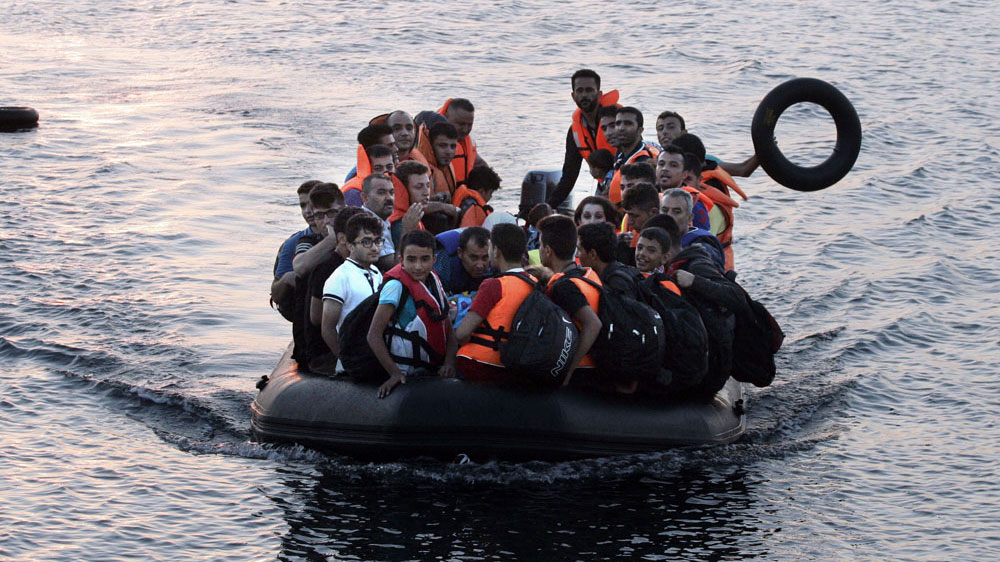
According to the UN, the majority of those landing on Europe's shores are fleeing war [Yannis Behrakis/Reuters]

About the Author

Barry Malone


Imagine waking your children in the morning. Imagine feeding and dressing them. Imagine pulling a little girl’s hair into a ponytail, arguing with a little boy about which pair of shoes he wants to wear.
 
Now imagine, as you are doing that, you know later today you will strap their vulnerable bodies into enveloping life jackets and take them with you in a rubber dinghy - through waters that have claimed many who have done the same.
 
Think of the story you’d have to tell to reassure them. Think of trying to make it fun. Consider the emotional strength needed to smile at them and conceal your fear.
 
There is no "migrant crisis" in the Mediterranean.

What would it feel like if that experience – your frantic flight from war – was then diminished by a media that crudely labelled you and your family "migrants"?
And imagine having little voice to counter a description so commonly used by governments and journalists.
The umbrella term migrant is no longer fit for purpose when it comes to describing the horror unfolding in the Mediterranean. It has evolved from its dictionary definitions into a tool that dehumanises and distances, a blunt pejorative.
 
It is not hundreds of people who drown when a boat goes down in the Mediterranean, nor even hundreds of refugees. It is hundreds of migrants. It is not a person – like you, filled with thoughts and history and hopes – who is on the tracks delaying a train. It is a migrant. A nuisance.
It already feels like we are putting a value on the word. Migrant deaths are not worth as much to the media as the deaths of others - which means that their lives are not. Drowning disasters drop further and further down news bulletins. We rarely talk about the dead as individuals anymore. They are numbers.
 
When we in the media do this, when we apply reductive terminology to people, we help to create an environment in which a British foreign minister can refer to "marauding migrants," and in which hate speech and thinly veiled racism can fester.
 
We become the enablers of governments who have political reasons for not calling those drowning in the Mediterranean what the majority of them are: refugees.
 
We give weight to those who want only to see economic migrants.
The argument that most of those risking everything to land on Europe’s shores are doing it for money is not supported by the facts.
[Milos Bicanski/Al Jazeera]  
According to the UN, the overwhelming majority of these people are escaping war. The largest group are fleeing Syria, a country in which an estimated 220,000 to more than 300,000 people have been killed during its appalling and escalating war.
 
Many others come from Afghanistan, Iraq, Libya, Eritrea and Somalia – all places from which people are commonly given asylum.
 
There is no "migrant" crisis in the Mediterranean. There is a very large number of refugees fleeing unimaginable misery and danger and a smaller number of people trying to escape the sort of poverty that drives some to desperation.
 One-minute explainer
So far this year, nearly 340,000 people in these circumstances have crossed Europe's borders. A large number, for sure, but still only 0.045 percent of Europe's total population of 740 million.  
 
Contrast that with Turkey, which hosts 1.8 million refugees from Syria alone. Lebanon, in which there are more than one million Syrians. Even Iraq, struggling with a war of its own, is home to more than 200,000 people who have fled its neighbour.
 
There are no easy answers and taking in refugees is a difficult challenge for any country but, to find solutions, an honest conversation is necessary.
 
And much of that conversation is shaped by the media.
 
For reasons of accuracy, the director of news at Al Jazeera English, Salah Negm, has decided that we will no longer use the word migrant in this context. We will instead, where appropriate, say refugee.
 
At this network, we try hard through our journalism to be the voice of those people in our world who, for whatever reason, find themselves without one.
 
Migrant is a word that strips suffering people of voice. Substituting refugee for it is – in the smallest way – an attempt to give some back.
Barry Malone is an online editor at Al Jazeera. Twitter @malonebarry
[Milos Bicanski/Al Jazeera]
Source: Al Jazeera

Dozens of refugees found dead in truck in Austria

Up to 50 dead, Austrian police say, as German Chancellor Merkel meets Balkan leaders in Vi

More than 28,300 people applied for refugee protection in Austria in the first half of the year, with many coming from Syria [EPA]
Up to 50 refugees have been found dead in a truck in Austria, as German Chancellor Angela Merkel and Balkan leaders gathered in Vienna to decide on how to tackle together the biggest migration crisis to hit Europe since World War II.
The vehicle, which contained between 20 and 50 bodies, was found on a parking strip off the highway in Burgenland state, police spokesman Hans Peter Doskozil said at a Thursday press conference with Interior Minister Johanna Mikl-Leitner.
"This tragedy affects us all deeply," Mikl-Leitner said. "Human traffickers are criminals. Anyone still thinking that they're kind helpers cannot be helped."
It was not immediately clear how the people in the truck had died, nor how long they had been there.
More than 28,300 people applied for refugee protection in Austria in the first half of the year, with many coming from Syria.
At the talks in Vienna, Merkel said everyone had been "shaken" by news of the bodies found.
"We are of course all shaken by the appalling news," Merkel said.
"This reminds us that we must tackle quickly the issue of immigration and in a European spirit - that means in a spirit of solidarity - and to find solutions."
Balkans route
The talks come amid growing criticism of the European Union's failure to agree on a joint response to the unfolding crisis.
Countries taking part include Macedonia and Serbia, two major transit nations for the thousands of migrants and refugees trying to enter the EU by taking the so-called "western Balkans route".

The foreign ministers of both countries called for a concerted EU action plan at the start of the summit.

"Unless we have a European answer to this crisis ... no one should be under any illusion that this will be solved," Macedonia's Nikola Poposki said.

Related: Migrant crisis a failure of European policy, UN says

Meanwhile, EU member state Hungary, which is a member of the EU's passport-free Schengen zone and has become the bloc's main entry point for migrants arriving by land along the Balkans route, was not at the meeting.

The daily number of people crossing into Hungary hit a new high on Wednesday, topping 3,000, including nearly 700 children, police figures showed. Hungarian lawmakers will debate next week whether to deploy troops to stem the influx.

Alarmed by the growing humanitarian disaster, United Nations chief Ban Ki-moon has urged countries "in Europe and elsewhere to prove their compassion and do much more to bring an end to the crisis".

UN refugee chief Antonio Guterres and French Interior Minister Bernard Cazeneuve meanwhile have called for the urgent creation of more so-called "hotspots" - processing centres to sort refugees fleeing war, from economic migrants simply in search of a better life.

RELATED: A Syrian family's journey to a new life in Germany

Nearly 300,000 people have crossed the Mediterranean this year with 2,373 migrants and refugees dying in a bid to reach Europe, nearly 300 more than the same period last year, according to the International Organization for Migration (IOM).
migrants
Hungary has plans to reinforce its southern border with helicopters, mounted police and dogs [Reuters]
Source: Al Jazeera and agencies


Tuesday, August 25, 2015

Streams of refugees flow into Macedonia from Greece

Hundreds pass through the border unhindered as police allow groups to enter Macedonia a day after violent clashes.


Hundreds of refugees have passed through the Macedonian border from Greece unhindered a day after police used stun grenades in a failed bid to prevent them from crossing.
Al Jazeera's Andrew Simmons, reporting from Gevgelija on the Macedonian side of the border, said the refugees were boarding trains to take them from Macedonia to Serbia.
The refugees hope that by taking trains through Serbia, they will make it to Hungary and other EU member states.
We are humans. We are not animals. We ran away from death and came here to die from the border police?
Syrian refugee on the border
Al Jazeera's Jonah Hull, reporting from Idomeni on the Greek side of the border, said the railway between the two nations was working again on Sunday.
"It is calm here. There is a free flow of movement as the Macedonian police allow small groups through," he said.
"There are lines and lines of refugees making their way to this point and there is no sign in the bigger picture that this flow is going to stop or slow down anytime soon."

RELATED: Greece ships Syrians to Athens as refugee crisis mounts

Police and security remained at the border on Sunday, checking the refugees belongings and bags as they allowed them to pass through.
"Heavy diggers at work are essentially clearing the ground alongside these railway tracks where over 2-3 acres are covered with human waste, abandoned tents, abandoned bags, clothing, children's toys, and empty bottles of water," Hull said.
Our correspondent said that while hundreds on Saturday night had managed to cross the border by sprinting through open fields, many others had been sent back to Greece, where they alleged harsh treatment from Macedonian police and showed Al Jazeera their injuries.
One Syrian refugee told Al Jazeera what is happening to them is not what they expected when they fled Syria.
"We just want to pass or at least let those who are sick or with children pass. We are humans. We are not animals. We ran away from death and came here to die from the border police? Or from the cold?" the refugee said.
"Is it our fault there is fighting in our country? This is not fair.
"We are nothing to them, our passports are nothing to them. Imagine if this were you in our place, we have children. Don't you have children? Wouldn't you want the same?"
Ahmed Satuf, another refugee from Idlib in Syria, told Al Jazeera he didn't want anything from Macedonia, except for being allowed to cross its borders.
"I'm not a terrorist. We are humans. Where's the humanity? Where's the world? Everyone here, they are families," he said.
"We don't need anything. We don't need money. Let us cross. I want to go to Germany."
Source: Al Jazeera

Politics and polemics: Europe's immigration story

We analyse the media coverage of the immigration debate; plus, Cuban bloggers and their quest for freedom of expression.


The front pages of British newspapers have been dominated by one story these last few weeks - migrants trying to get into the country through the Channel Tunnel that connects the UK with France.
The tone of some of that coverage has characterised these individuals - many fleeing cash-strapped or war-torn countries - as posing a threat to both British resources and security. When you break down the relatively low number of migrants entering the UK, the amount of attention this story gets in the mainstream media may seem disproportionate. And the way that it is covered says more about the political agendas of the news outlets doing the reporting than about the story that needs to be told.
Given the current political climate in Europe with the rise of right-wing, anti-immigrant parties across the continent this is a story that needs to be contextualised and its terminology analysed.
Talking us through the story is writer and broadcaster Richard Seymour; Arun Kundani, the author of The End of Tolerance; Jonathan Portes, an Economist journalist; and Fatima Manji, a reporter with Channel 4 News in the UK.

Other media stories that we have been tracking this week: a photojournalist has been murdered in Mexico bringing the death toll of media workers in the country this year to seven; in Malaysia, an arrest warrant has been issued for a website editor and two publications have been suspended for their coverage of a corruption scandal; and the BBC has been allowed back into Iran after being locked out for six years.
Cuban bloggers and their quest for freedom of expression
With the diplomatic thaw taking place between Havana and Washington, The Listening Post examined what it means for the Cuban media landscape.
In our third and final segment on this story we take a look at the growing community of dissident bloggers and journalists in the country.
In 2011, the country's president, Raul Castro called on Cubans to be more critical of the government. However, some saw that as a cosmetic statement. Internet connectivity on the island is an issue and although there is growing number of critical voices online, they are only accessible to those who can afford to log on.
In this week's feature, Marcela Pizarro speaks to three independent journalists about their work and the impact they are having in the Cuban blogosphere.

If you were following the coverage in the Huffington Post's UK website or Britain's Daily Mail newspaper then you would have been lead to believe that Adbou Diouf was a Senegalese migrant making his way to Spain and documenting his journey on Instagram.
But the images posted and the entire online persona were fake.
They were put together by Tomas Pena, a Spanish filmmaker who said that he wanted to highlight what he called "western frivolity", selfie culture and the notion that a life "hasn't been lived, if it hasn't been shared." The Instagram account attracted almost 10,000 followers and when the truth was revealed Pena produced a 60-second short film from the feed. We made it our Endnote video and hope that you enjoy it as much as we did.
Source: Al Jazeera

Migrants or refugees?

Thousands fleeing conflict in desperation have been undermined by language used by the media to describe their plight.


Macedonian police used tear gas to drive back refugees at the border. On Thursday, they declared a state of emergency, which means the army will be deployed to stop people transiting through the country.
Germany wants to see measures to stop new arrivals travelling unchecked through Europe.
The country is expecting a record 800,000 people to apply for asylum this year - that is more than the entire EU combined in 2014.
British and French authorities have announced a new "command and control centre" in Calais.
Five thousand people are living in makeshift camps, awaiting the chance to smuggle themselves into the UK.
Their journey to safety is even hindered by the language used to describe their experience.
Inside Story asks: Are they migrants or refugees?
Presenter: Mike Hanna
Guests:
Gauri Van Gulik: Deputy director for Amnesty International in Europe and Central Asia.
Adrian Berry: Chair of the Immigration Practitioners' Association.
Francois Gemenne: Research Fellow from the Centre for Ethnic and Migration Studies.
Source: Al Jazeera

Record number of refugees enter Hungary from Serbia

More than 2,000 refugees crossed frontier on Monday, just days before Hungary completes a border fence.

A record number of refugees streamed into EU member Hungary from Serbia, police said, just days before Hungary completes a border fence.
A total of 2,093 potential asylum seekers, the highest ever daily total, crossed the border near the Hungarian town of Roszke, a police statement said on Monday.
They were part of a wave of around 8,000 refugees whose journey to the European Union had been blocked last week when Macedonia declared a state of emergency and closed its borders after being overwhelmed by the huge influx of people, amid Europe's worst refugee crisis since World War II.
Many refugees said they had passed through Serbia after travelling through Macedonia's border with Greece.
"We were stopped in Macedonia for two days, the riots were terrible, police used guns and tear gas, I saw an old woman beaten, her money and papers taken," a 29-year-old IT engineer from Mosul in Iraq told the AFP news agency.
Al Jazeera's Djordge Kostic, reporting from the border with Hungary, said an estimated 1,500 refugees are currently staying at 28 shelters set up by the UN and Russian-Serbian aid organisation in the city of Kanjiza.
He said the refugee situation at Kanjiza is "better organised" than in other parts of Serbia.

RELATED: Refugees race through Balkans in bid to beat Hungary fence

"There is water, food, toilet and shower stalls provided to them. They even have Wi-Fi," he said.
From there, the refugees can proceed to Horgos, about 12km away, where they can take the train to Hungary, our correspondent said.
Meanwhile,Al Jazeera's Aljosa Milenkovic, reporting from Presevo on the Serbia-Macedonia border, said more refugees were likely to come, "putting to test the region's ability to cope with the large number of people transiting through".
The latest movements came as German Chancellor Angela Merkel and French President Francois Hollande called for a unified system for the right to asylum, and the setting up of reception centres in Greece and Italy.
The issue is set to top the agenda at a summit of Balkan leaders on Thursday, which Merkel will attend.
Razor-wire fence
Hungary has registered more than 100,000 asylum seekers so far in 2015, over double the total for all of last year. In 2012, the figure was just 2,000.
Thousands of refugees cross into Serbia
The numbers have sharply increased to around 1,500 a day in August, after Hungary's conservative government announced it would build a razor-wire fence along its southern border with Serbia.
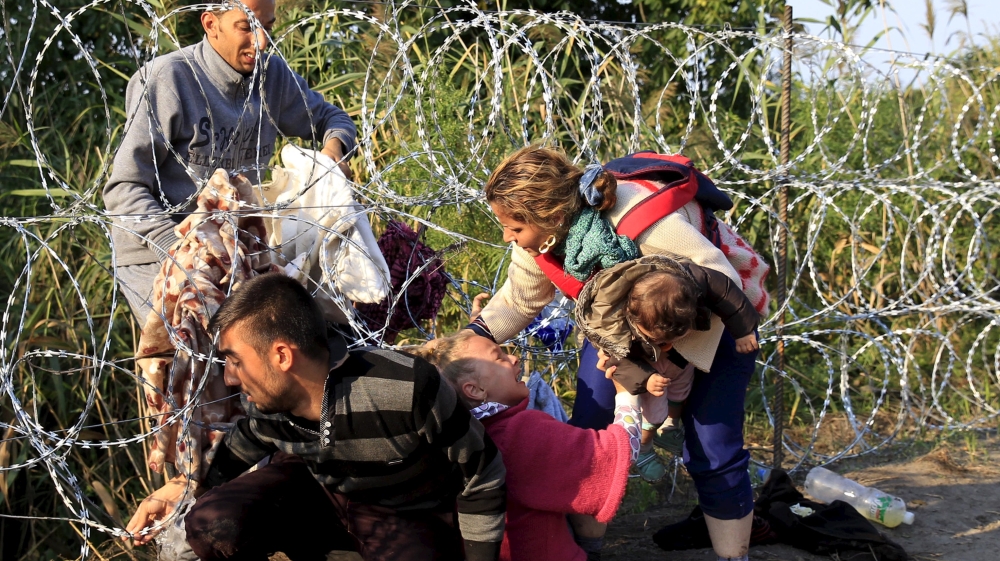
In recent days, refugees have entered Hungary alongside a cross-border train track near Roszke, one of the few sections of the border with Serbia not yet blocked by three rolls of razor-wire, which the government says will completely seal off the border by August 31.
The fence is one of several measures making it more difficult for refugees to enter and stay in Hungary. The government is also tightening asylum laws, introducing penalties for illegal border-crossing, and the planned closure of permanent refugee camps.
About 102,000 "migrants" entered the EU via Macedonia, Serbia, Bosnia and Herzegovina, Albania, Montenegro or Kosovo between January and July this year, versus just 8,000 for the same period in 2014, according to EU border agency Frontex.
The number of refugees now making their way from Greece towards the EU is worrying many EU politicians and has left the Balkan countries struggling to cope with the humanitarian crisis.
Source: Al Jazeera and agencies